★★★★★ Review

Diane writes:

First, a disclaimer…. I have had a business relationship with Mr. O’Neary, as he has done some research on my Irish roots in the past. However, this has nothing to do with my review of “Where’s Merrill?” My review is based totally on its own merits.

As somewhat of an ancestry buff, I was interested in reading “Where’s Merrill?” I too have Irish roots, though other than being Irish, my family bears little resemblance to the Harrison family.

Where’s Merrill?” is a well-written ancestral mystery. I enjoyed the dual stories of the past and the present, as it seemed to tie into my own interests of digging into the past with my own family. I, too, have sought out & found distant relatives, and it’s quite fun to find relations you never knew you had! “Where’s Merrill?” certainly tops my own family in terms of real drama & mystery! I’m afraid my own family is quite boring compared with Merrill’s!

I would definitely recommend “Where’s Merrill?” to others who are interested in ancestry & a little mystery! Here’s a suggestion to others who are reading “Where’s Merrill?“: throughout the book, there are several family tree graphics. Bookmark these pages so that you can easily refer back to them. I found it a little hard to keep track of “who was who” along the way. It’s useful to be able to refer back to the family tree graphics to refresh one’s memory. I had at first thought it would be good to have one complete family tree graphic at the beginning of the book. But that would have, in fact, spoiled some of the surprises in this family mystery! So bookmarking along the way seems to work out best if you are like me, and need visuals to help your memory.

Overall – a good book!! And looking forward to more books by O’Neary!!

2014 April - Amazon #1b

You can choose your friends – but not your Ancestors

A recent purchaser of my novel “Where’s Merrill?” posted a mediocre review, and made the following bizarre observation:

“Write about someone more interesting next time”

Considering that this true story is sub-titled a genealogical thriller, and that it is now listed for sale as a genealogy reference book as well as a fictionalized thriller, the reviewer seems to have completely missed the point about Family History research. You cannot choose your ancestors. They are who they were. They are not made-up characters or a figment of a fantasy writer’s creative but far-fetched mind. It took all my willpower to not commit the author’s Cardinal Sin of responding directly to the negative reviewer with my personal feelings about the ridiculousness of their publicized opinion.

When you research your own family history, you might start out with a little knowledge about your ancestors’ backgrounds based upon memory or passed-down tales. However, when a genealogist is commissioned to research the ancestry of a complete stranger, possibly from a different country, then no-one can predict where the trail is going to lead. This is what makes genealogy so interesting, and such fun at times, and occasionally and tragically, so very sad. One thing is certain – you cannot manufacture your findings to be “more interesting” than they are.

It is also difficult to fathom why my dissatisfied reader finds Merrill to be dull. His researched life story was selected from over 3000 genealogy case histories to demonstrate the surprises that can lurk in anyone’s ancestral closet. Outwardly, as a young man, Merrill appeared to live a dream life; a successful businessman with a beautiful wife and two children. Then cracks start to appear. Hints at unsavoury vices, violent outbursts and dramatic lifestyle changes creep into the tale. Why? What caused this man to spiral downwards until he just vanished from the planet? And why would no-one talk about what happened? That is what makes Merrill so very, very interesting. It is not fiction. I have no control over the places Merrill resided in or the people he associated with. More importantly, I cannot change who Merrill was related to in a tangled Family Tree inhabited by some very dark characters.

Merrill had his good points and his bad points – like us all. No-one should be judged purely on their final chapter.

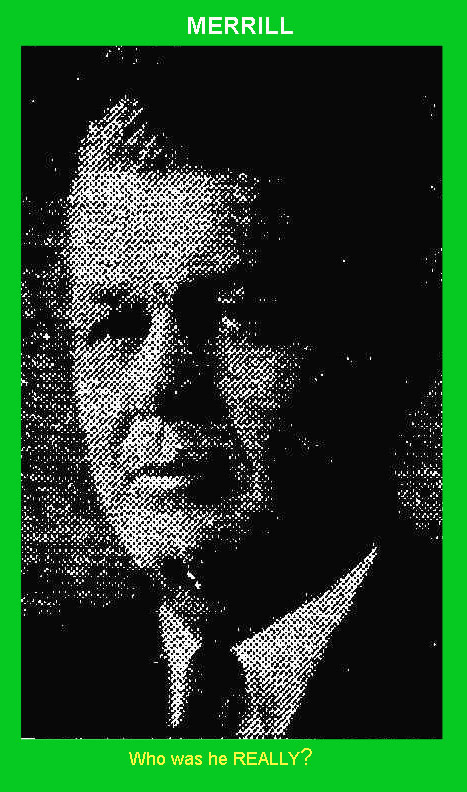
1934 October (Merrill)

The Burning of Tubbercurry

I am always fascinated by the fact that there are still living witnesses in our parish who saw from afar the local town of Tubbercurry ablaze, during a night of infamous terror. This event occurred in October 1920, so our witnesses are aged 100+. There must be something in the South Sligo water because we have more than our fair share of centenarians. Obviously, the number of survivors is dwindling yearly – but the tale is etched into the consciousness of all elderly and not so old Tubbercurry natives.

Wolfe Tone Square

               Tubbercurry 100 years ago

Nationalist rebels had been active in South Sligo for 50 years when the Irish War of Independence erupted at the beginning of 1919. Decades of anti-British sentiment saw ordinary Irish men and boys take up arms against their oppressors. Tubbercurry and surrounding districts instantly became a hotbed of secret IRA military offensives. Well-organized small units in each parish soon became masterly at the new art of guerrilla warfare. Constabulary and judicial targets were attacked in surprise overnight raids, and then the IRA soldiers disappeared back to their farms and cottages. The perpetrators were very difficult to distinguish from innocent civilians, thwarting British military leaders who were more used to fighting a visible army.

By 1920, a pattern of IRA ambushes followed by indiscriminate British-backed reprisals had been established, leading to ever-greater atrocities. The British Government sent in WW1-hardened troops to assist the overrun Irish Constabulary. These mercenary war veterans were ill-disciplined and regularly counter-attacked non-military Irish businesses. As a result, the whole of Ireland rose up to ensure that British rule over the island was ended once and for all.

IRB soldiers

            A typical Flying Column unit of IRA soldiers, young and old

Wartime events in our locality reached a terrifying peak on the night of 30th September 1920. An IRA Flying Column unit successfully ambushed a police and military patrol on the outskirts of Tubbercurry. The aim of the mission was to kill, wound or capture a recently-appointed Police Inspector, thereby sending out a loud message of local defiance. After a gun battle, the Police Inspector was fatally wounded, and the IRA retreated without suffering any losses. The British reprisal attack was swift and brutal. A company of “Black and Tans” entered the once-sleepy town of Tubbercurry and proceeded to burn the shops and homes of suspected IRA sympathizers. As the town was composed of adjoining terraced streets, soon the whole town centre was ablaze with women and children in fear of their lives. A small number of town-based IRA Volunteers could not quell the outrageous violence of an out-of-control British Army.

Read local Commander John Brennan’s witness statement to gain a full overview of the nature of the frightening War of Independence in Sligo: 1918 Tubbercurry Volunteers

After 30 months of fighting a losing battle, the British called a Truce and political dialogue about Home Rule provisions commenced. Then a short but tragic Civil War broke out as squabbles about the governance of the new Nation got out of control. Peace eventually prevailed in 1922. Local memories are long – but somehow, former enemies were graciously forgiven and Tubbercurry re-emerged from a charred past as though nothing had ever happened. That’s how it is today, and that is why it’s amazing, considering that living witnesses are still around.

My Brick Wall

In genealogy circles, the common term for a seemingly insurmountable research dead-end is a “brick wall.” Professional genealogists have the experience to know that a classic brick wall cannot be scaled – but if you keep digging, and dig deep enough, you might just be able to squeeze part-way through a hole and take a peek at the other side. And what you see might convince you to give up trying to go through that brick wall; it’s pointless. There was nothing of value on the other side. On the other hand, a glimpse of something bright and shiny might inspire you to reverse back a bit, head off to the side (not losing sight of that wall), nudge forward and eventually come out somewhere on the far side of that brick barrier that was holding you back for so long. Then you can start to try and make sense of things in a strange new place, but you can, eventually – if you stick around.

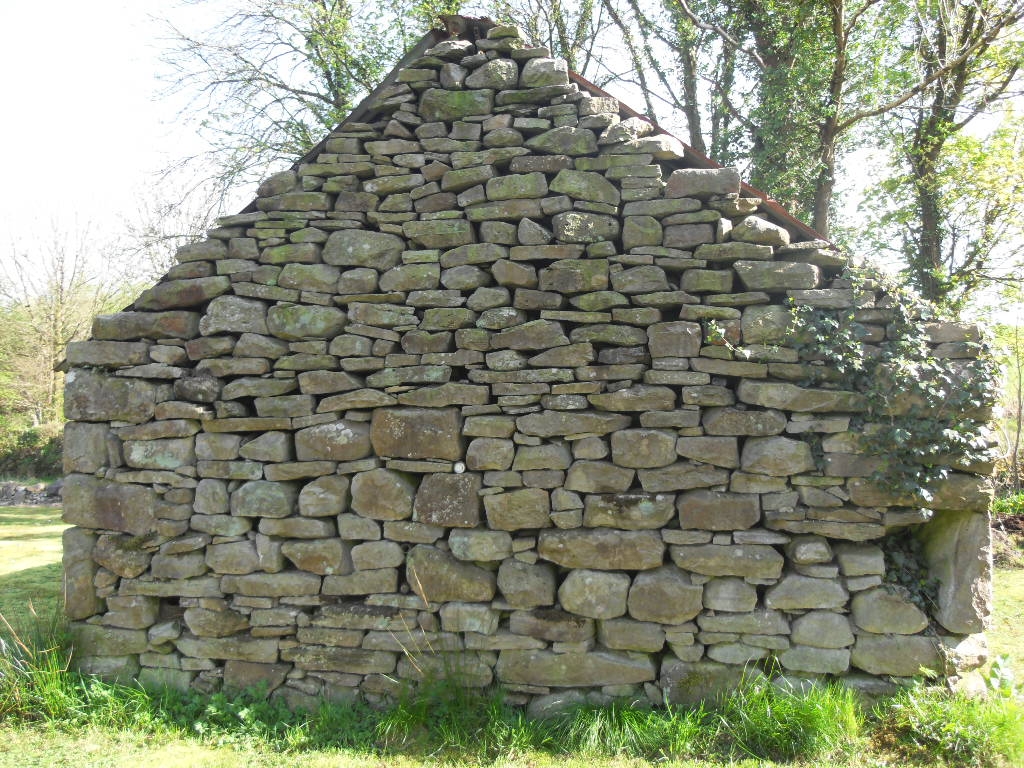
My personal brick wall (shown below) is a beautiful thing and pointless. Well, if you look closely enough, you will see that there is no pointing. No mortar. There never was. It’s a work of art; ancient Irish art.

VLUU L310W L313 M310W / Samsung L310W L313 M310WMy wall is the gable-end of an ancient Irish stone barn. It has withstood all weathers for over 200 years. It is a State-protected structure, and I am the Protector because it sits on my property. I wish that this meant that the State would contribute to the upkeep of the structure, but no! Oh no – as the private Protector, I am expected to privately raise my own funds and get on with the Protecting without a cent of State assistance. Of course, if my beloved wall ever falls down, then I am in big trouble … with the State – who would not hesitate to prosecute me for trying my best, spending a fortune, but ultimately failing, alone, in my lifelong task.

“Where’s Merrill?” in most book shops (not all)

When I advised that my novel Where’s Merrill? is available in most of the popular book outlets in many sales territories, I should have clarified that my Genealogical Thriller is not stocked in this particular shop:

Wong Book Store #1

∞ ∞ ∞ ∞ ∞

The complete novel

is available at:

© AMAZON or

© LULU or

© SMASHWORDS

∞ ∞ ∞ ∞ ∞

Aclare: back then, and now

Thanks to Gordon Parker, a remarkable snapshot of forgotten life in a village in rural County Sligo has re-surfaced and returned home after over 50 years. Gordon’s family, based in London, recorded the image below in Aclare village way back in August 1961 when touring Ireland on a summer holiday. The rare, high quality colour picture was captured by using the now defunct Kodachrome camera film with the resultant photograph then developed and mounted as a slide, for viewing through a projector. The age of the digital camera has made all that processing a thing of the past … like an ass-cart.

1961 August - Aclare, Sligo

The village is full of asses …. in 1961

The date of Gordon’s photo is significant, i.e. August. The village of Aclare was full of animals and other eccentric characters because the Parkers passed through on the Summer Fair Day. The (sometimes infamous) history of this once well-known and important livestock trading fair has been discussed in previous posts. Refer to Aclare Fair Day and Old Fair Day (Revived).

VLUU L310W L313 M310W / Samsung L310W L313 M310W

The asses have all gone; never to return

A story every Irish Ancestry Researcher should read

Here’s a tale that resonates with my own research into the origins of an elusive O’Connor from “somewhere in Ireland” told here: Johanna

Never give up. You just never know ….

[courtesy of Mary O’Connor Tossell and Irish Central]

“The O’Connor family bible came into my possession after the death of my grandparents. I noticed within it, a few pages with lists of family birth, death and marriage information dating back to the mid 1800s that I’d never seen before. Not long after, I received a 1924 newspaper article celebrating my great grandparent’s 50th wedding anniversary from a second cousin, with lots of family details that were new to me. I realized there was a lot I didn’t know and, ironically, those that could help with any questions were no longer here to answer them. I will forever berate myself as to why I hadn’t thought to I ask them when they were still alive.

In the spring of 1997, armed with this additional information, I hoped an answer to a seemingly unanswerable question might now be within reach. I was inspired to embark on a grand journey, to find the answer to my quest.

Where in Ireland did my O’Connor family come from?

I didn’t have a clue as to a townland nor even a county. I really only knew the names of my great grandparents, and that one of my ancestors was born in Ireland. (I wasn’t even sure which generation!) I thought the next step should be to try to find out who was buried in our O’Connor cemetery plot back where my grandparents came from in Vermont, hoping that might lead to a birth place in Ireland written on a tombstone or a burial record. If not, I thought at least it would help to locate their vital records once I determined exact dates.

While inquiring by phone long distance at the family cemetery, a very kind person going the extra mile at the rectory in Brattleboro, Vermont said:

“Wait, there’s another plot of O’Connors”.

“What?!”

To my great surprise as it turns out, she revealed the names of my previously unknown to me, great great grandparents. I never even knew they were buried there. If she hadn’t bothered, I may never have known! No mention though, of a birthplace other than merely “Ireland” and alas, no indication either on the tombstones themselves.

So, my emigrant ancestors were Maurice O’Connor and his wife Catherine Martin, both born 1822 according to the gravemarker. It was they, I later came to find out, who made the trek across the Atlantic during the worst part of the so called Irish Potato Famine; 1847, aka Black ’47, the year of the “coffin ships” into Quebec….or maybe I should say the starvation! Oh, but don’t get me started on that one, that is for another time to tell.

Next step was to try to locate Maurice’s death listing from the Brattleboro town clerk’s office to obtain the month and day and maybe a birthplace, as I now had a year of death from the cemetery information. I was merely calling to find out how to go about getting a death certificate if you only had a year i.e. 1898, when the clerk asked me to wait while she checked. She had gone to a dusty shelf and pulled out the ledger for 1898! Would you believe it, she actually went through it month by month to finally find Maurice’s death listed in October of that year, on the 20th – evidence of yet another kindness that advanced my quest that much forward.

But wait, that wasn’t all. As she went across the line of information she read aloud, and came to this:

Parents: Hugh and Johanna O’Connor

Wow! The names of my great great great grandparents. As I was only looking for dates, that was a pretty exciting, unexpected find in itself! Ah yet again, it only said “Ireland” as a birthplace. At least I now had an exact death date. Maybe I could find an obituary that might mention a townland.

By the end of 1997, I was getting rather depressed. I had already tried searching the Brattleboro church and cemetery records, tombstone markings, birth, death, marriage certificates, funeral parlor papers, Vermont Federal Census films, town directories, Vermont genealogy societies, U.S. naturalization papers, passenger lists, civil war veterans & Irish railroad worker references, and the local Family History Center (the Mormons). If I was lucky at all; they said merely “Ireland” as a birthplace. The naturalization papers I obtained from the National Archives in Waltham, Ma. had “Great Britain” even. But no townland mentioned, ever.

I had run out of ideas on how to find a townland in Ireland for my emigrant ancestors… after all this searching I still had no clue where my O’Connor family came from in Ireland. It was beginning to dawn on me that there was a possibility I might never find the answer to my quest.

It started to haunt me, “Would I ever know?” It was at this point that I remember thinking aloud to myself…

“Come on Maurice and Catherine, give me a hand here!”

It was only a few days later that I received an envelope in the mail from the Brooks Library, Brattleboro, Vt. I had all but forgotten having written, months earlier, requesting a search in their microfiche for an obituary in the local 1890s era newspaper. When I hadn’t heard from them, I figured they didn’t come up with anything. But now I had this envelope, I’ll never forget, it was on Jan 3rd 1998…

I realized immediately the significance of the information this envelope may contain. I paused before opening it while I weighed this thought in my mind… Either it had, or it did not have my great great grandfather’s obituary in it. I knew full well this might be my last good chance to find out the place in Ireland where my O’Connors were from … and if not there… Well, I can honestly say I was almost afraid to find out what was inside.

My hands were shaking as I opened the envelope to see what lay there in…

I gasped, as it was a photo copy of a newspaper page. Could it be… an obituary? I could barely take in a breath as I read:

THE VERMONT PHOENIX

Obituary

“Maurice O’Connor…died Oct 20, 1898…he was born in 1823, at Mt. Brendon, Co Clare, Ireland

Oh my Gosh! There it was! My eyes filled with tears as I realized after all this searching, at last, in black and white;

THE TOWNLAND!

My excitement was short lived…I was anxious to see exactly where Mt Brendon was, so I got on the internet to look for maps of County Clare. I found some good maps. But after much of what turned into frantic searching, I sadly realized, there is no such townland called Mt Brendon then or now in County Clare!

Now what? I was very discouraged.

Well I kept digging. I did find a village called Brandon, in County Kerry, on the eastern slopes of a mountain called Brandon… could this be it? … and would that mean I’d have to conclude my ancestor did not know what county he was from!? By this time I was really starting to doubt the usefulness of my newly discovered “find”.

Actually the more I thought about it, maybe County Kerry was the place to search… after all, it did have a Mt Brandon! In the meantime, I saw another site on the internet about tourism in Ireland and County Kerry where the village of Brandon was on the Dingle Peninsula; and was looking at prices of Bed and Breakfast places etc. … mistily dreaming about a someday trip to the Mt Brandon area; in the event that it might prove to be the right place….

When low and behold, begosh and begorrah, I spotted an email address for The Stone Cottage B&B in a town called Dingle whose proprietors at the time were named Becky and Michael O’Connor. What the heck, on an impulse, knowing full well it may be for naught, I emailed them.

I received an email back from them the next day. They were not my O’Connors (yeah, I knew I was just stabbing in the dark!)… but Becky did say there were O’Connors in the area of the village of Brandon, and that I should visit the O’Connors Pub and Guesthouse in Cloghane (pronounced Cla HANE) near to Brandon sometime and ask them. As I wasn’t planning a trip to Ireland any time soon, I instead wrote to the O’Connor Pub and Guesthouse that was mentioned and sent what family history I was aware of … and then promptly put it out of my mind. No use getting my hopes up. Still, wasn’t it nice of her to suggest though?

About a week later I got a phone call …from Ireland! It was the proprietor of the guesthouse, Sean O’Dowd! Although not an O’Connor- his wife was, for which I congratulated him on (haha!). But alas, his wife’s O’Connors also were not related to me either. (Of course, what was I thinking?) Searching for O’Connors in Ireland is like looking for Smiths or Jones in the U.S. (BTW I have discovered O’Connor is one of the oldest of Irish Gaelic surnames, and has a great and glorious history!)

Mr. O’Dowd gave me some hope though about the discrepancy regarding Mt Brandon being referred to as being in County Clare but actually being located in County Kerry . He suggested that if my ancestor, being an Irish Gaelic speaker (Dingle is a Gaeltacht {Irish speaking} area to this day), that the pronunciation of “Mt Brandon, Co Kerry” in the Irish, might sound like “Mt Brendan, Co Clare” to the untrained ear… and as Maurice, my ancestor, did not read or write (surely a result of the Penal Laws against Catholics. Oops, there I go getting off on a tangent again!) he would not have even recognized such an error himself.
2006 DP5Oh and then there was this; Mr O’Dowd also said he would talk to some other O’Connors that he knew for me, who lived on “the other side of the mountain” from the O’Connor guesthouse in Cloghane. (Mr O’Dowd lived on the eastern side). I thought it was really nice of him, but wasn’t expecting much, … after all, there are 30 thousand O’Connors in County Kerry! Considering after all, we weren’t even related, wasn’t it nice of Mr. O’Dowd to bother!?

(For O’Connor researchers; This particular sept of O’Connors {there are 6 separate clans}, calls itself O’Connor-Kerry. Contemporary descendants of this sept are by far the most numerous, and those from Dingle are called the Dingle O’Connor Branch of the O’Connor-Kerry.)

Now get this…The very next day, Jan 22, 1998, I was coming into the house carrying groceries when I heard this curious voice leaving a message on the answering machine…. It sounded Irish! I dropped what I was doing and quickly picked up the phone. It was a man who introduced himself as ‘Himself’* O’Connor of Bally – – -, Dingle, County Kerry, Ireland. (on the western side of Mt Brandon.)

*’Himself’ of course gave me his name but because so many genies have contacted him asking for help I’ve had to remove his name and location for his own sake (and mine!)

‘Himself’ told me he read my information given to him by his dear friend Sean O’Dowd of O’Connor’s Guesthouse and wanted me to know that his great great great grandparents were also called Hugh and Johanna O’Connor. The same names as my great great great grandparents… and they too had a son Maurice who emigrated to America …the same name as my emigrant ancestor! ‘Himself’ descended from a son John of theirs and as it turns out, I might be descended from John’s brother Maurice!

He gave me a marriage date for Hugh and Johanna in 1810; and a birth date in 1821 for Maurice (which fit with what I had… which was a range of 1820-1823 from varying answers in the Vermont Fed Census films, and his gravestone, and the obituary).

He also gave me the names of his Maurice’s siblings, with many familiar given names that I also have in my family; but then again, what Irish family did not have a John, James, Catherine and a Mary back then ?! (BTW I read that 29% of all the women in Ireland were named Mary in the 1850’s!) He also gave a possible explanation for the non existent Mount Brandon townland given as a birthplace …

Its because Maurice O’Connor was born on a cliff in the foothills of Mt Brandon! He left County Kerry because the farm his father had purchased for him had a landslide in 1847 the same year my Maurice emigrated. He said he had a lot more information for me, that he would write it all out. If this really was my Maurice, Wow…. what a find!! I could hardly believe it. I was so excited hearing all this, my hands were shaking trying to write it all down. I could barely read my handwriting afterward and I almost forgot about my quickly defrosting groceries!

There was only one flaw in it all…

When I was young, I remember asking the question; “Why of all places, did our family end up in Brattleboro, Vt ?” The answer was: “That’s where the work on the railroad ended.” …also family history had it that; “The brothers moved on to Chicago to look for work there”. But ‘Himself’ said his Maurice was the only one in the family of that generation to have emigrated, his brothers had not. Hmmm…. as my family was so vague about our roots I wasn’t even sure which generation worked on the railroad … was it my great grandfather John or my great great grandfather Maurice? The real question was, could ‘Himself”s Maurice really be MY Maurice? I needed to do a bit more research to prove the connection… but I must admit, my instincts told me this was probably my family.

There was something strangely eerie about it all, something I didn’t pick up on ’till later, when I was replaying the answering machine message for my husband that ‘Himself’ had started to leave before I picked up.

… it was that ‘Himself’ sounded so very much like my dad ! It was just as if it was my dad talking with a brogue! It was uncanny! It also made me feel like I really had spoken with the Irish descendants of my ancestors from “across the pond”!

To top it all off, ‘Himself’ owns “Tigh ‘Himself'” in Bally – – – Co Kerry. That’s Irish Gaelic for ‘Himself”s Place… a PUB!! What better spot to have a pint and toast your mutual Irish ancestors than Tigh ‘Himself’!? Is that the Luck of the Irish or what?

Please read on, the story doesn’t end here…it gets better!

I thought I would share another tidbit with you about my O’Connor genealogy research, I think its kind of romantic… also some of the info may be helpful to other researchers.

GET THIS! Back in the mid 1800’s to the early 1900’s, the Irish from all over the states posted notices in the “Boston Pilot” newspaper, in search of missing friends and loved ones. This was “the” place to put such a notice. The 6th vol. in a series of 8 books is recently out, covering up to the U.S. civil war period which has gathered all these notices in $45 a piece volumes… quite a hefty price for only one volume even… so not expecting anything, but wanting to rule out a major source of info, and to take advantage of a very kind offer… look what I found when someone on the internet was generous enough to offer to do lookups in her volume, the first of the series:

“The Search for Missing Friends: Irish Immigrant Advertisements Placed in the Boston Pilot” (Volume 1 1831-1850. page 236, 13 November 1847, Information Wanted

OF CATHERINE O’CONNOR, wife of Morris O’Connor, daughter to James Martin of Graan, near Dingle, co Kerry, who emigrated to Quebec last summer, with her brothers, John and James Martin, and is supposed to be in Upper Canada. Any information respecting her will be thankfully received by her husband, who is separated from her by the adversities of fortune. Address, Morris O’Connor, care of James O’Connor, Cabotville, Mass.

WOW! Turns out Graan is a phonetic pronunciation of Garrane, Co Kerry, its in the adjoining parish of Kilmalkedar, next to where Maurice was born, in Kilquane Parish which ‘Himself’ O’Connor told me about when I last reported to you. If this is the right Morris and Catherine, which I think it is, that ad was placed by my great great grandfather! Prior to this I didn’t know if they were married in the U.S. or Ireland (looks like Ireland), I didn’t know Catherine Martin’s father or brothers names!, nor when they emigrated nor where they were from in Ireland!

This could be an answer regarding the “brothers going on to Chicago”, and ‘Himself”s Maurice’s siblings not having emigrated at all… it may have been **Catherine’s Brothers** who moved on to Chicago! That’s IF its a match of course. I’ve also read that the Irish back then used the terms brother and brother-in-law interchangeably. Now I just needed proof…. something to make the connection between my U.S. O’Connor/Martin info and ‘Himself”s O’Connors in Ireland.

Note: Neither Catherine nor Morris could read or write, can you imagine how desperate they must have been, and how helpless they were to try to find each other when they didn’t even speak English in this new and vast country?… countries I should say; America and French speaking Canada !

Epilogue – When I sent the “Missing Persons” ad information to ‘Himself’ O’Connor, he talked the very reluctant local priest in Ballyferriter Roman Catholic parish near Dingle (which contained Kilquane and Kilmalkedar civil parishes) into letting him look at the actual parish records, in Latin! – which by the way, haven’t been filmed by the LDS (the Mormons) like most of the rest of Ireland and the world really….and guess what…

‘Himself’ looked up the marriage record for his Maurice O’Connor; married Shrove Tuesday, Feb. 22, 1846 and spouse; Catherine Martin (parents James Martin and Catherine Moriarty)!… and the whole Martin family births, marriages, just like the ad, in Garrane!!!

IT WAS THEM!

This confirms the Dingle connection to my Maurice from Brattleboro Vt, and my newly discovered 3rd cousin ‘Himself’ O’Connor and family in Bally – – -, Dingle, Co Kerry! I was so excited! And when I said that to ‘Himself’ he said;

“Oh, don’t be excited, it’s just us.”

Ever since I started my research over a year ago I’ve had this idea; that someday, if I ever found where Maurice was born, that I’d bring a bit of dirt from Maurice’s gravesite in Vermont with me for a future visit to Ireland. So how about this… ‘Himself’ told me that the very same land that Maurice was born on, near Mt Brandon (the real townland name by the way, is Clash) is still in the O’Connor family to this day!! Between his Irish brogue and his unique (to me) vocabulary; I wasn’t sure and couldn’t quite make out what he said next… I thought he said:

“The house still exists.”

“Still exists! You mean, I might be able to see it?”

Then I thought he said, “Yes, but it’s a cow house now.”

(Cow house?)

“‘Himself’, What do you mean by; ‘it’s a cow house now’?”

(obviously, a city girl <G>) …after a long pause he said, “Mary…. its where we keep the cows. Now what did you think it was, girl?”

So much for my romantic notions of bringing back a bit of Vermont to Mt Brandon! On second thought, I think maybe Hugh and Johanna’s gravesite would be appropriate don’t ya think? and by the way… Catherine and Maurice must have gotten together after that ad was placed in Nov. 1847 sometime by the next summer; around August of 1848; because my great grandfather John James O’Connor, was born June 17, 1849!

I heard again from my 3rd cousin; ‘Himself’ O’Connor in Ireland… (or should I say ‘Himself’Ó Conchúir; he does!) He sent me a letter; with family group sheets included (with notes in Irish Gaelic!). After searching parish records in Ballyferriter Roman Catholic parish **confirming** our family connection he told me this, which is really what I wanted to share with you;

“We are sure now, that our Maurice Ó Conchúir, is the same man you are looking for”… and later he finished with:

“We are sure now, you are ours.”

‘Himself’ signed it with: “Le mheas mhór, ‘Himself'” (with great love, in Irish Gaelic) Pretty neat, eh? It gave me goosebumps when I first read it… and it still does.

I hope you’ve enjoyed my story, and that it encourages you to keep trying! Máire Ó Conchúir Tossell aka Waterlilys@aol.com.

Follow: @IrishCentral on Twitter | IrishCentral on Facebook

#1 AMAZON Best-Seller (Genealogy Category)

2014 April - Amazon #1aOn 6th April, the true family history saga novelized as “Where’s Merrill?” hit the #1 Spot in the Amazon Best-Seller hit parade. A big thank-you to all readers, whether you be fans of genealogy or mystery thrillers. The book obviously has appeal in both categories having scaled the heights in both best-seller lists.

And the interest continued … and #1 was not a flash in the pan >>

2014 April - Amazon #1b

1865 – Abraham Lincoln’s funeral procession through NYC

I know … it’s a tenuous link – but if this newly-discovered quad photo really is the work of famed American Civil War photographer, Mathew Brady, then here we have the only known photograph of the momentous funeral procession of Abraham Lincoln’s corpse as it passed through New York City en route from Washington DC to Springfield, Illinois, for burial in April 1865.

And … if … this photo was taken outside of the magnificent Grace Episcopal Church on Broadway, then surely my distant ancestor, Patrick Reilly from County Cavan is in the photo. You see, Patrick worked as an Irish immigrant NYC stonemason on the building of the Grace Church, and he lived nearby in 1865. Four years earlier, Patrick answered the call of Civil War recruiting sergeants and enlisted in the 15th Regiment of the New York State Volunteers. He went on to become a Union Army Engineer, building crucial temporary bridges prior to Union advances into Confederate territory. His President, Abraham Lincoln, personally inspected some of Patrick’s handiwork.

So … there he is … somewhere in this historic snap created by using a four-lens camera and developed on to a large plate glass negative.

1865 April - lincolnfuneral

I think that’s him – 14th from the right, in the Union Army uniform

Are there any other genealogy jokes? Not gynaecology; ha ha

Is this the best that the comedy industry can do:

How many Genealogists does it take to change a light-bulb?

Answer = Six (no, seven Einstein!)

1879 Edison bulb

1879 – a very old bulb – possibly belonging to Uncle Edison

One to travel to the factory to record the exact age and unique identifying number of the bulb.

One to check whether the bulb’s socket lineage is “live” or deceased.

One to trace the power line back to the pole.

Two to argue over the name of the original pole where the line started.

One to screw in the new bulb and write a detailed biographical account of the experience, complete with verifiable research sources, of course.

And one more to track the subsequent lives of the photons which emanated from the bulb.

It’s so funny, I almost chortled in the library. Sorry.

Is your Irish ancestral name ‘cast in stone’?

The spelling of ancient Irish surnames evolved over time. Originally, they were written in the unique Irish language; a strain of the Gaelic tongue spoken by ancient Britons. During more recent centuries, these names were converted to the Anglicized versions in common usage today. In reality, the accurate spelling of a family name was of little importance to most members of the family, as they were invariably illiterate or semi-literate at best. Our Irish ancestors were more concerned with the pronunciation of names because heritage tales were passed down the generations by word of mouth, rather than in written text.

The situation regarding phonetic genealogy can become more confused by the influence of local dialects in many parts of Ireland. My own surname of Neary is only pronounced as Neary in the east of Ireland, as well as in England and America where family branches re-settled after emigration. In the west of Ireland, where the Neary clan has its roots, the family name is spoken as Narey or even Narry using the local accent. As a consequence, this is how the name appears in many old documents. The record-keepers of the day simply wrote family names as spoken by informants with very little concern for spelling accuracy.

This scenario must be borne in mind by family history researchers when delving into Irish ancestry. Often, quite bizarrely, the first step in the research process is a reassessment of “your name.” Could it be that your Irish family name, as used by every forefather in living memory, was not your name at all?

An example of this genealogy conundrum is demonstrated in the images below. A large extended family in Massachusetts, descended from Irish immigrants, were always known as McKay, McKey or Mackey – but which surname was correct. The answer was proved to be “none of the above”!

I found that my particular research subject, Irish-born John McKay, adopted and used the McKay name in America for over four decades. Most of his siblings also accepted Americanized names when establishing their own families near to Boston. As a result, when John McKay died in 1913, his US death certificate notifies the world that John McKay, originally from Tipperary and son of Patrick, died in Chatham MA, aged 95.

1913 MA death (John)I had to use many unconventional research techniques before I was able to verify that John McKay was not really a McKay, or a McKey, or a McAnything! In this case, a strange but delightful twist in the tail permits me to reveal John’s true name by displaying it “in stone” via his grave marker. It would appear that the surviving offspring of John McKay knew all along that he was not a McKay, even though the male American lineage continued to be known as McKay! As shown below, John’s real and ancient surname was respectfully engraved on to his tombstone. Note that the dates of birth and death match up perfectly with the death cert of John McKay.

John Mulcahy & Ellen Donovan HeadstoneAs you might appreciate, it is difficult to interrogate computer databases to investigate a chosen ancestor’s background if you unknowingly have the incorrect surname. Doubly so in this project … because John Mulcahy’s father was not called Patrick, as written clearly on his death certificate. His father was Perry, an Irish nickname for Peter – but that’s a story for another day.

Merrill was obviously not the only person who left a confusing background trail to bamboozle researchers, generations later. In Merrill’s case, it was deliberate.

St Patrick’s Day – Breaking News

I cannot be the only person in the world that marvels at the marketing expertise of the Saint Patrick of Ireland corporation. Somehow, during the mists of pagan times, an immigrant holy man wandered across our ancient (wet and multi-dull coloured) isle of Ireland. Our forefathers liked what he had to say. He came across as an alright-sort of fellow, on good terms with the heavens above, but his name was a bit of a mouthful – so we called him Patrick, and he didn’t seem to mind.

Our Patrick got a big following (before the days of Twitter) and so we called him a Saint, particularly for walking up big mountains without decent hiking boots. We could spot him a mile off because of his distinctive clothing … which was never green.

So let’s all raise a glass of the British-owned, world-renowned, unique black beer called Guinness …. and celebrate the life of a Welshman who wasn’t called Patrick and didn’t wear green. This is the definition of “Irish” yes? Party. What the hell.

saint-patrick blogBy the way, you can get my novel for free via Smashwords for this St Patrick’s Day weekend by entering this code: PM77U at St Pat’s Thriller

Editorial Book Review

By Joseph Spuckler of Author Alliance:

Where’s Merrill? A Genealogical Thriller by Gearoid O’Neary is a cross between a research paper and a mystery. I really did not know what to expect with this book initially, but was won over fairly quickly. Trying to find Merrill in a family history reminded me of my days as a history major and searching for minor historical figures. In fact, my classmates and I had done this sort of thing so often in so many Latin American history classes that this research took on its own name. No matter who we were researching, the joke was his name is Juan Obscuro. So reading about someone searching down a person using historical records was not that intriguing to me. The author, as the main character, searching for someone else’s Juan Obscuro really seemed monotonous to me.

But, my initial thoughts were wrong. Jed, the main character, was a former engineer riding high on the building boom in Ireland when it crashed. Corporate backlash and Jed’s feeling of duty to his people, left him out on the street. He, in turn, turned a hobby into a career: Genealogy. Well, here was something positive I could relate to. I was a project manager riding high on the telecom wave when it crashed, and likewise, I found myself unemployed. I turned my hobby into a career: Bicycle mechanics. I was surprised that someone could earn a good living researching people’s past as I am sure that people are surprised a bicycle mechanic can earn a good living. Anyway, that sealed my bond with Jed, and his wife Susan. No high-life, but real hard working people and a reasonably good life.

Tim is the American, who asks Jed to help find his past. Tim’s mother, when she was alive, hid her family’s past. Now that she was gone, Tim could discover his past without upsetting his mother or going against her wishes. Here too, I was pleasantly surprised. Jed and Sue had a far more interesting time researching Tim’s family than I ever did researching Juan. The history crosses the American Midwest, from Iowa and up in to Minnesota. It spreads to California and Washington, D.C.. There are several twists and turns in the research too. What is expected and reported is not always what happened. Merrill, is a particularly difficult subject to track and not always by accident. The story jumps back and forth between Jed and Susan and the search for Merrill. The Jed’s and Susan’s story runs chronologically. The genealogy part of the story jumps back and forth as new pieces of information are found and new family members are found and traced, but it does flow very logically.

I was expecting a novelization of a dry research paper when I started this book. I was pleasantly surprised by the actual story. It was far more than I could have expected; interesting is an understatement. The writing is very well done, although at the beginning chapters the conversation seemed a little forced, but that impression also disappeared as I read further in the book. I also found the process of the research interesting too. I never realized that there was that much of an infrastructure for records going that far back. I had expected many records to be lost, destroyed, forgotten, or just simply no longer worth keeping by the local government. A very interesting read whether you are interested in genealogy or not. The story resulting from the search is definitely worth the read as historical fiction — the research is real — the names have been changed and conversations inserted. Very well done. Joe Spuckler

Joe awarded “Where’s Merrill?” four out of five stars – but as he readily admits, the Evil Cyclist does not toss out his review stars willy-nilly.

Joe’s twitter handle: @Evil_Cyclist

The Good, The Bad, and Dad

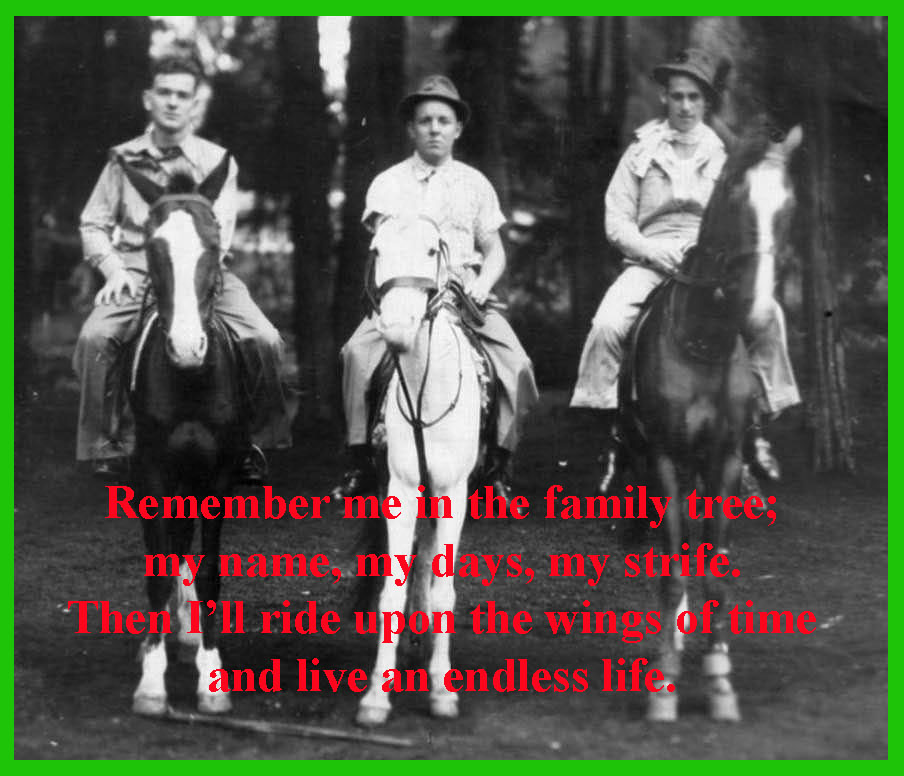
DadonrightThe photo above featuring my father always caused amusement and curious interest when it was viewed in the family photo album, particularly after his untimely death at the young age of 54. The snap was christened “The Good, the Bad, and Dad” by his irreverent sons, more in recognition of their liking for Spaghetti Westerns than any comment on my dad’s colleagues. You see, my dad is on the right, and we don’t know the identity of the other two young men. We don’t even know where the photo was taken, except that my Irish dad was conscripted into the Royal Navy upon resettlement in England, and he once told tales of sailing around the world, with stop-offs on exotic islands in SE Asia. Perhaps this photo was taken in Borneo, or somewhere like that.

So we don’t really know if the tall handsome man on the left was “Good” or if the shorter streetwise lad in the middle was “Bad” – but thankfully we do have a single picture of Dad as a cool-looking bachelor boy exploring the world. I have learned from interviews with Dad’s old Irish school-friend, Eddie Moran, that my father was an accomplished horseman. My grandfather Ned Neary kept horses and donkeys at the old farm in Tullinaglug, and Eddie and my dad rode them bareback-style whenever Ned was occupied elsewhere.

My dad’s life was not fully appreciated until he was gone. His strife involved escaping from poverty in rural Ireland, living in a tiny run-down old two-roomed Irish cottage with a thatched roof, but Dad ended up providing a spacious six-bedroomed detached house with attractive gardens for his large family, of which I am one. Not a bad return for a poorly-educated manual worker … and he saw more of far-flung Asian destinations than I’ll ever see.

The short poem written on to the image is courtesy of Linda Goetsch, a fellow genealogy fanatic. “Remember Me” is rapidly becoming the genealogist’s equivalent of the Lord’s Prayer. The words just seemed 100% appropriate to accompany The Good, The Bad, and Dad.

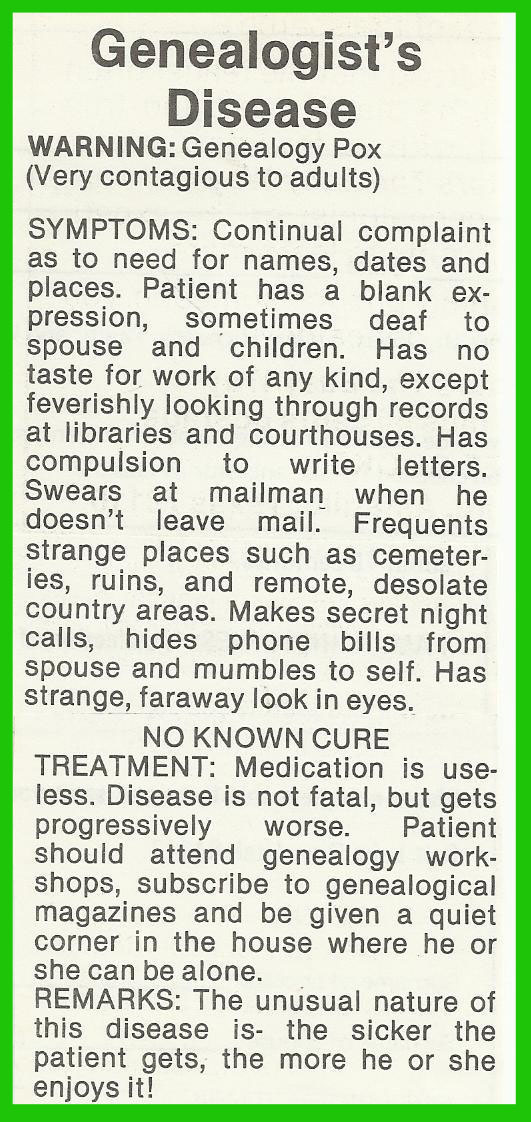
Genealogy-itis

There can only be one explanation for the unsavoury behaviour displayed below.

Archives are closed today

Yes – the genealogy pox virus is getting out of control. A recent survey of the most searched-for keywords on the internet concluded that genealogy is the most popular hobby in the world – according to Google robots assessing our every move, of course. I don’t suppose that Google et al have devised a way to tell whether lovers of the great outdoors, or regularly active sportsmen and women, etc, like their pastimes more than bashing away at a computer keyboard.

Regardless, I am not ashamed to admit that the never-ending search to fully understand why I exist, and why I live where I do, and why I am like I am – and more importantly – why I should be so grateful for my comfortable existence – occupies my mind every day.Genealogyitis

Passion and disease are very similar, except that in the latter case the subject wants to get better … and never go back in time. A passionate genealogist wants to get better by travelling back in time in order to understand his or her true self.

A passionate successful genealogist exhibits a warm, empathetic glow as he or she observes the travails of less fortunate souls. This is WISDOM.


Enjoy your illness – if that is what it is.


There ain’t no sanity clause

It was Chico Marx who came out with this memorable play on words, way back in 1935 in the Marx Brothers film “A Night At The Opera.” Chico was playing his usual street-wise Italian-American immigrant character when conniving Groucho asked him to sign a contract containing a “Sanity Clause.” In Chico-speak, the full reply was:

“You can’t a fool a me; there ain’t no Sanity Clause”

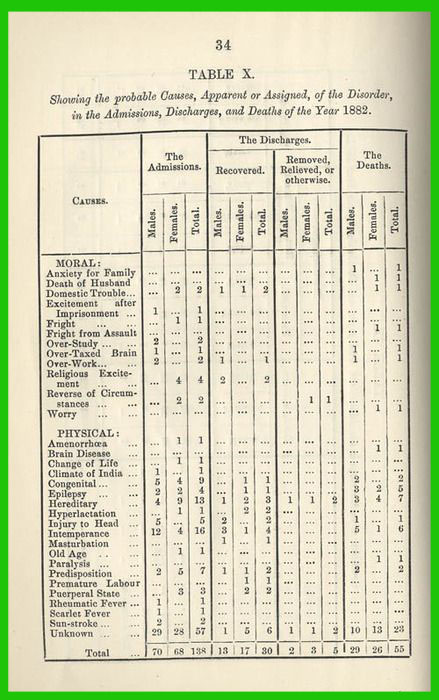
Decades ago, mental illness was not understood, and thus assessed and treated in bizarre ways. There is still lots to learn about brain diseases and their triggers, but thankfully the general condition is now accepted as biological fact and not some sign of weakness of character. Without wishing to belittle the sufferers of modern-day mental illness (or their admirable carers), I found the detailed analysis of the inmates of a Lunatic Asylum in 1882 [shown below] to be both amusing and illuminating.

1882 Insanity ReportMy observations are:

  • The death of a wife does not make men mad.
  • Domestic trouble can sometimes lead to a sex-change.
  • Prison life can be exciting for some men.
  • Too much study is bad for boys, and over-taxing the brain can lead to death.
  • You can recover from working too hard – or die.
  • Women can be excited by the Religious Orders, but men can get over this.
  • Do not worry about being diagnosed as insane or you will stop worrying forever.
  • Men cannot suffer from amennorhea – period.
  • In 1882, brain disease only affected 1 in 228 Lunatic Asylum inmates.
  • The “Change of Life” is as bad as amennorhea – period.
  • The “Change of Life” is as bad as the climate in India.
  • Congenital brain diseases have nothing to do with genitalia – fact.
  • Male heirs are only half as mad as female heirs.
  • Don’t let hyperlactation get on your tits – both made a recovery.
  • Don’t get mad drunk too often; you could end up in the Salvation Army hostel.
  • I think it says that you can recover from masturbation. My eyesight is bad.
  • Some old women are plain daft … well, one was.
  • If you are predisposed to thinking you are insane, you probably are.
  • Premature Conservatives are infantile, and harmless.
  • The Puerperal State is full of crazy women.
  • Sun-beds are safe for females.
  • After all of this analysis, we are clueless about 40% of the asylum’s inmates.

In 1882, only a quarter of this selection of institutionalized mental patients died in their sanatorium; a better survival rate than hospitals of the day dealing with chronic diseases. And this study group stood a better chance of recovery than their peers diagnosed with purely physical symptoms in the Workhouses. Madness? Even the Victorians knew that mental ailments were not contagious. Perhaps it was wiser to feign insanity than to be incarcerated alongside really sick people … a bit like the Public Health Service today.

John Neary aged (almost) 90

It is appropriate that I am writing this post about my Irish cousin John Neary on one of the days of early February. The precise date is irrelevant. The conflicting facts are:

  1. John Neary was born on 1st February 1924, making him aged 90+
  2. John Neary was NOT born on 1st February 1924, making him aged almost 90

This conundrum is a recurring theme in Irish Ancestry Research which I have to explain over and over again to inexperienced family historians. Why do our Irish ancestors have one date on their birth certificates and (more often than not) other dates that they claim are their true birthdays? Unfamiliar amateur researchers often whine that they cannot find a birth cert which matches their ancestor’s known birthday from passed-down family lore. Or, on the contrary, they reject indisputably correct birth data because they have retrieved a birth certificate which displays a specific birth date in black and white, and therefore it cannot be challenged …. or can it?

The reason for the conflict is surprisingly quite simple – and it is a phenomenon which continued into the first half of the 20th century.

When an Irish Catholic baby was born in rural Ireland, the priority was to get the child baptized pronto before any illness threatened its chances of surviving into infancy and beyond. And I mean quickly, e.g. typically within 72 hours of birth. The reasoning was that Roman Catholics believed that no-one could enter Heaven unless they were baptized. If a non-christened baby died a day or two after delivery, then it was sent to “Limbo” – and a poor mite in limbo was not in Hell but could never reach Heaven. So a RC baby was baptized in a hurry, and a small fee was paid to the parish priest, and baby’s head was wetted in the church, or wherever convenient, and again by the proud parents at home, or in the local pub. And that was that – job done.

Then, a few weeks later, someone would remind the Irish parents (anytime after 1863!) that the British rulers now demanded that the baby’s birth must be registered with the local Civil Registrar, and for this nonsensical burden, the poor parents would be charged another fee. The birth registration was often postponed until funds were raised, or the proud parents were threatened with a court appearance plus fine for non-registration. Next, one parent was tasked with heading into town to find the Registrar’s Office, and this could be a major (costly) journey if the town was 10 or 15 miles away. Usually the father “volunteered” to carry out the despised process on the town’s next market day, or maybe the one after. Perhaps he could sell some livestock to pay for a darned birth certificate.

And so it came to pass, after a considerable interval of several weeks stretching to months, that Dad ventures into the Registrar’s Office to declare that his wife’s delivered his fifth or sixth or seventh (etc.) son or daughter. Dad might remember the correct child’s name – but not always. He almost certainly could not remember the exact birth date of his latest progeny … and didn’t really care, so long as the child’s name appeared in the holy baptismal register back at home. Most of these dads from the rural farming community were ill-educated, and one can imagine that a wild guess at a birthday was narrowed down to a particular period between notable events such as Holy Days, depending how conscientious the underpaid Registrar was. The result of all this haphazardness was that (usually) Dad came home with a birth cert showing something like the name of the family’s latest addition alongside an arbitrary date demanded by an unloved official representing the government – not the sacred church. To compound matters, this unwanted certificate was screwed up and hidden in a drawer, never to be used again … because a Baptismal Certificate had a much higher importance in any Catholic household of old.

Now it starts to make sense. This is why many Catholics use their date of baptism as their DOB. This is why DOB’s on ancient Irish birth certs are (more often than not) completely misleading. This is why you can have an Irish ancestor who was apparently baptized before he was born! Always try to inspect the original baptismal register entry featuring your Irish ancestor and TRUST the info gleaned – above fancy-looking birth certs, or conflicting census data, or any other despised official document.

John Neary says that he was baptized in mid-February 1924, and so he adopted 14th February as his birthday (if asked). However, he never celebrated his birthday until he was in his ninth decade. He and his family could never afford to. Not many Irish farming families could. How can a poverty-stricken RC family throw 12 or 14 parties a year for their offspring. And so, sadly, birthdays are ignored and forgotten about. They are more important to genealogists and descendants than they ever were to our actual Irish ancestors.

John Neary’s birth certificate says that he was born on 1st Feb 1924. John knows that that is wrong but that is what it says on all his official documents such as his pension paperwork. He respects the date for ID purposes, and respects his dad for at least getting the month correct when the Registrar grilled him! From all the available evidence, we can only guess that John was really born on or about 12th February 1924. Does it matter? What DOB would you put on his gravestone when John eventually starts his journey to Heaven?

VLUU L310W L313 M310W / Samsung L310W L313 M310W

John Neary born (circa) 1st February 1924

The main thing is …. doesn’t he look in rude health for a man born just after the Irish Free State came into existence.

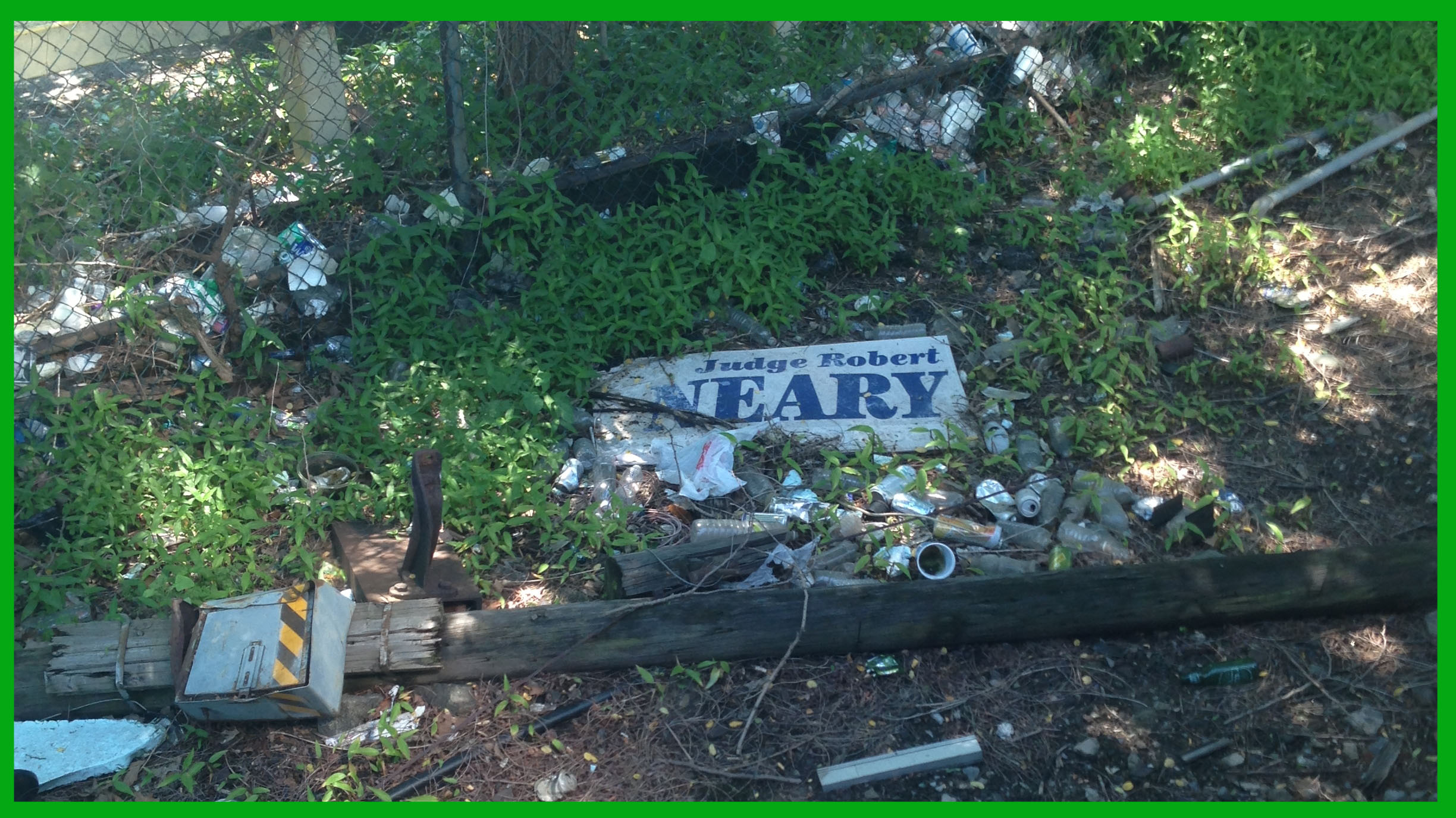
Trashed

Some members of my extended ancestral family became big-shots in the complex Irish American politics of NYC. Many didn’t.

I don’t think that Judge Robert Neary is one of my direct ancestral clan, but to throw out the Westchester Judge’s election rally paraphernalia on to the Bronx rail-side dumping ground is a bit much. Maybe he deserved it; who knows?

Judge Robert A Neary

Irish Ancestry Research HQ

2010 was [very] cold. 2014 is very windy and wet. One tree down, and one stray large branch did some damage to the “kitty compound”.

Gearoid O'Neary's avatarWhere's Merrill?

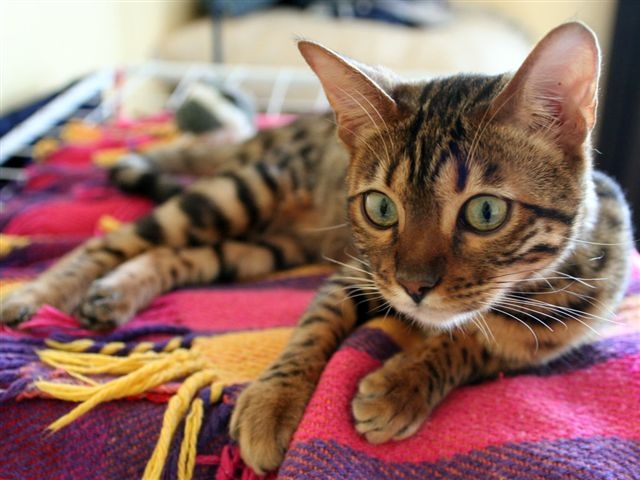
This Bengal cat knows the answer.

A Bengal pedigree hybrid cat is the fourth generation offspring resulting from breeding an Asian Snow Leopard with a domestic feline. These beautiful animals of gentle temperament retain the golden-spotted markings of a leopard on their underside, a tiger-like shiny striped coat and distinctive “mascara” markings around the eyes and face.

Bengal Beauty

Back to More Merrill Musings

View original post

1879 – NYC Boxing Bout lasting 52 Rounds ends in stalemate (and court appearances)

I have been researching a very colourful distant cousin named Ned Mallahan born in Connecticut in 1849. Our Ned sparred as a boxer as a young man, whilst also establishing himself as a purveyor of fine liquors as he traveled around America demonstrating the noble art.

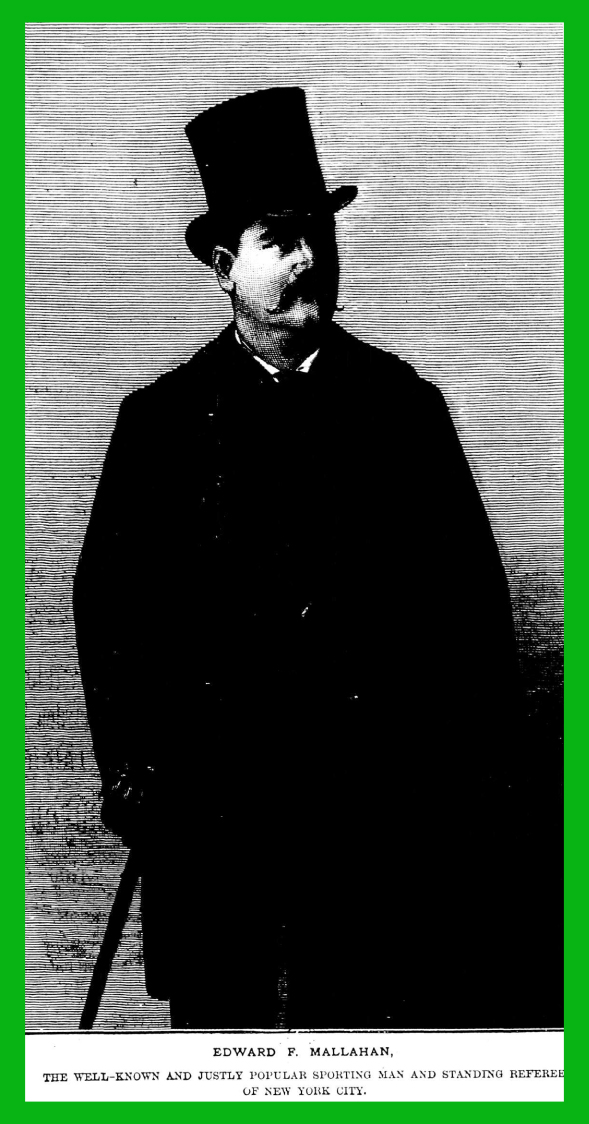
1886 Ned Mallahan portraitIn his mid-twenties, Ned settled in Manhattan and formed business partnerships with like-minded young sportsmen. Ned became a respected boxing referee, trainer and promoter. By the late 1870’s, Ned had assembled the most talented (or most ruthless) stable of raw Irish immigrant pugilists. With funding from supportive NYC sports fanatics, Ned organized fight night extravaganzas featuring infamous brawlers, boxers and wrestlers. His theatre houses were packed every weekend.

The Pantomime Villain image of the popular Edward F Mallahan on the left dates from 1886 when Ned could not have been a day over 37 years. He looks much older after a life grappling in carnival tents.

I found the newspaper report in the link below on the back page of the New York Herald. It reports on the much-anticipated international lightweight boxing bout between local hero Mike Coburn and “Spring” Dick Goodwin, an English challenger, on Friday night, 21st February 1879. As you will see, the display of fistic science went on and on, for 52 rounds, lasting 3 hours and 46 minutes. Even the NY Herald reporter was becoming exhausted by the contest. The eager hack had started off by writing up a round-by-round account of the encounter, but after 25 rounds he was out of words, and out of column space.

I sense that most observers were somewhat relieved when the NY Police raided the premises and brought a halt to the gruesome spectacle by arresting all involved, including the spectators, and the boxers, and Coburn’s corner-man and boxing impresario, Ned Mallahan. You see, professional boxing was illegal in NYC in 1879 – but still Back-Page headline news.

1879 NY Herald (Mick Coburn v Spring Dick)

I love the last “impartial” words of the loyal Herald newsman. When Coburn appeared before Justice Morgan the next morning [he] “did not seem to have a blemish on him” – after enduring 3 hours and 46 minutes in the ring with the fearsome English sporting gent, Spring Dick.


The Best View in Ireland

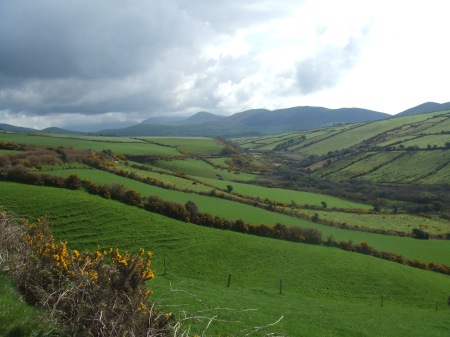
Where is the best view in Ireland?

Maybe you’re taking things for granted. It could be right outside of your window.

2006 DP3STRAIGHT AHEAD

2006 DP4

                                                                                                         To The Right


Ooh Nice

2006 DP5

To The Left


A Family Tragedy (and a valuable genealogy lesson learned)

Many years ago, when I started researching my Family Tree, I did not have a clue about my grandfather Ned Neary‘s birth family. After some time, I eventually discovered that Ned was the youngest of twelve siblings; there were six boys and six girls. I knew nothing about any of them, except for Ned, and even he was referred to as Edward or Ted in my lifetime. It appears that “Ned” dropped his Irish nickname after leaving County Sligo in the late 1930’s in favour of the more Anglicized abbreviation of his baptismal forename. Ted Neary moved across the Irish Sea to England, and I suppose that the Irish immigrants of the day had to “fit in” and grudgingly accept the monikers which their new neighbours and workmates applied. However, back in Sligo, everyone remembered Ned as Ned, if you get my gist.

Anyway – I was not long into my ancestry research project when I set myself the challenge of tracking down each of grandfather Ned’s deceased siblings, and finding out about their lives. Both Ned and my father (Ned’s oldest child) were dead too, so they could not help my quest.

When researching the six Neary sisters, my new-found great-aunts, I soon learned that three of these ladies had got married in New York City, and had their own families, thereby introducing me to many second cousins. Three of my new cousins had an interest in their family history, and so they could recall passed-down tales about the three Neary sisters who lived their adult lives in the Bronx, and kept in regular touch with each other as an extended family. There was also mention of a fourth sister who emigrated to NYC in her youth but returned to Ireland broken-hearted when one of her siblings stole away her boyfriend – and married him! This sister was identified to be Bridget, and her return to the homestead led me to more fascinating ancestral tales – but more about this saga will be saved for another day.

So, I was left trying to trace the lives of just two Neary girls, amusingly called Annie and Fanny. I was getting nowhere until my oldest “new” cousin advised that there was a vague family lore tale about a Neary sister who died in a house fire in America, aged in her 20’s (he thought). Another cousin added some more detail: this Neary girl used to work as a domestic servant at a big house, somewhere in upstate NY. Which of Ned’s sisters burned to death? Was it Annie or Fanny? If only Ned was still alive to tell me about this “secret” tragedy.

Back in Ireland, I set about getting the first and main part of the jigsaw in place. Fanny was the youngest of the Neary sisters, and she appears in the 1911 census of Ireland, living alongside even younger Ned at the family farmstead in Sligo. I had an inkling that Fanny was not our fire victim because she would have had to have emigrated just after 1911 (to have died on American soil) and there was no sign of Fanny boarding or disembarking from a transatlantic ship during the 1910’s. My uncles and aunts (and elderly Sligo neighbours) were not aware of a Fanny Neary, so what happened to Fanny? A long search culminated in the discovery of Fanny’s death record. She died in the old Sligo town Asylum Hospital aged just 24 after contracting a form of TB. Poor Fanny – it seems like no-one could remember her time on this earth almost 100 years later. She is remembered now.

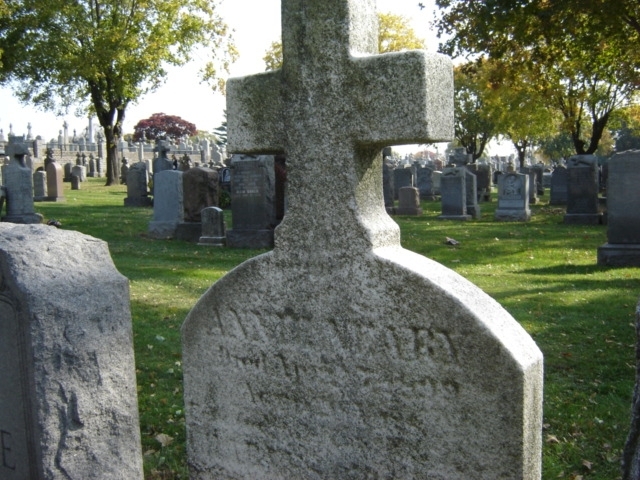
The Neary fire victim now had a name – Annie – if the fire story was true. My NY-based cousin Patrick Reilly became fascinated with the “Annie Neary Fire” story as well. As he said (with his legal training), the accidental death of an American would lead to an Inquest, and a house fire resulting in fatalities would be reported in local if not State-wide or national newspapers. Patrick decided to pay a visit to St Raymond’s cemetery in the Bronx where he knew that Neary and Reilly family graves existed. His hunch proved to be very wise. Patrick came across a weather-beaten old gravestone in the Catholic burial ground, sandwiched between newer grave markers of non-family members, which had been overlooked before. The faint but distinct name of Annie Neary was all that could be clearly deciphered from a long inscription. Patrick attempted to retrieve more data by “stenciling” the remaining characters of Annie’s memorial stone. The month of death was April, but the day and year were less clear. After close scrutiny, Patrick insisted that the date began with a “1” [of course!] and ended with a “9”. The second and third digits also looked like nines, but obviously this could not be. Patrick was aware that his Neary ancestors do not show up in Bronx registers until after 1900, and so a logical conclusion was drawn that Annie must have died in April 1909.

We now had a name, a date indicator, and a primary cause of death: FIRE. It couldn’t take much more research to unearth the truth …. could it?

Well … two years later, every reasonable research avenue had been investigated without success. Patrick visited Historical Societies and Vital Records Offices in counties to the north of New York City where the wealthier American families once had country retreats serviced by domestic staff. No sign of Annie – and no notable house fires in the first half of 1909. I searched accessible US newspaper archives, from NY and surrounding states. Still no sign of Annie – but (worryingly) a lot of fire fatalities in the papers in the 1900’s decade, and a lot of US history learned along the way.

Something was clearly not right. Maybe the dramatic “house fire” story was an over-exaggeration. Maybe Annie did once suffer minor burns, and then contracted an illness, and passed away without any great newsworthy fanfare.

A new and final, last-chance saloon research plan was devised. “Let’s retrieve any NY death certificates which feature a female called Ann Neary (or similar) whose year of death ended with the figure 9”, I suggested to Patrick. Whilst we are at it: “How about any deaths that end in the year 8 or 0, just in case the monumental engraver’s etchings have been misread.” As a (by that time) experienced researcher, I also confounded Patrick by proposing that matching namesake deaths from the 1880’s or 1890’s should not be ruled out. Weather-battered carved digits can play havoc with the logic of the human brain, I opined. “And don’t take it as ‘carved in stone’ that April was necessarily the true month of death. The headstone might after been erected years after the death, when accurate recollections had faded.”

We found that there were more than quite a few death certs which met the revised search criteria. Okay – let’s narrow it down to namesake death victims who were teenagers, or aged under 40. That’s better – a handful – and so Patrick ordered the documents for collection from the NY State archives within a few days.

I was staggered when Patrick sent me a copy of the last NY Death Certificate he had added to his list, shown below:

1899 NYC death cert (Annie Neary)

My great-aunt Annie, and Ned’s sister, had died in a fire on the night of 7th April 1899. She was aged 21 years. Back in Ireland, Ned was just five years old. We can only imagine the heart-rending grief in the tiny Neary cottage in Tullinaglug, days or weeks later, when the news filtered through.

The death cert gave us all the answers we needed. Annie was burnt to a cinder in the attic room of a multi-storey Manhattan home overlooking Central Park in New York City; a room reserved for the servants of the wealthy Andrews family. I am somewhat relieved and grateful that Annie’s employer, Mr Wallace Andrews, repeatedly tried to rescue his domestic staff trapped in their upstairs rooms. These rescue efforts cost him his own life. Annie’s oldest sister Mary was called to the Fire Station House in order to formally identify the charred remains. God knows how this task was completed, technically and emotionally.

The full story about the 1899 fire in central NYC is recalled in this initial New York Times article: 1899 THIRTEEN PERISH IN DOUBLE FIRE

I was shocked to learn that dramatic fires in the dry timber homes occupied by American city dwellers at the turn of the 20th century were frighteningly commonplace. A fire in one house often spread to a whole block.

So what’s the genealogy research lesson? Well, everything, really.

A family lore tale says that a relative died in tragic circumstances. First, identify the NAME. What happened? It’s probably based on the truth. Why would anyone make this stuff up. When did it happen? Focus on relative’s ages (at the time) rather than calendar years. If your family suffered a tragedy, say 20 or 30 years ago, you are more likely to say something like “I was aged about 25” rather than “it happened in 1989,” for example. Annie Neary was said to be in her twenties when her life ended in sheer terror and panic, far from home. She was only 21 and this tale got told to her sisters’ young grandchildren, who only half-listened, years after the event.

Where did the event happen? The grandchildren retained some memories of the oft-repeated obituary. Annie worked in “big houses” owned by ultra-wealthy NY families. In the summer months, she worked in second homes (mansions) located north of the city, around Westchester County, where the Andrews millionaires liked to escape to a cleaner environment. Not quite “upstate” but “up the State” for an Irish immigrant unfamiliar with American geography. But for most of the year, Annie Neary would be found cleaning out fireplaces and re-lighting fires in the 67th Street town-house of her employer. Annie’s brothers and sisters were very proud of their sibling. She was a much-loved and trusted member of the renowned Andrews [domestic] household.

ANgravestone1909#8And finally, rely on the eyes of your on-the-ground research colleagues. I was sent a photo of Annie’s tombstone which according to Patrick asserted a date of death ending in 9. I agreed, from long-distance, but I eventually started to question Patrick’s interpretation of the inscription. I put doubt into his mind, which was wrong. This error cost us unnecessary time and expense. We have since learned that Annie was buried in the Bronx in 1899 because she had an uncle (John Stenson) who was settled into this booming Irish neighborhood – but the death year always did end in 9.

When the dust had settled, Patrick and I re-visited lessons learned. Why did the clerk with the burial register at the Bronx cemetery never inform us about Annie’s burial in 1899? Answer:  …. because we kept saying that she died after 1900, and most likely in 1909. As it happens, when we specified our burial date, the clerk could tell us who else shared the grave and who paid for the burial plot. Priceless (early US) family history information which was almost lost forever.

And why did we never find the name of Annie Neary in newspaper reports of the many fires in New York city and state which occurred just over 100 years ago? Answer:  …. because some indexing systems only list the names of the primary fatalities (e.g. Andrews), and other automated scanning systems do not pick up “unfamiliar” surnames of American immigrants, especially if the newsprint is faded. Poor little Annie, the chambermaid, all the way from Tullinaglug; there she was on the bottom line of this New York Times front page article, all along: 1899 NYC fire (NYT)

So when investigating initially obscure ancestral events, maybe the research mantra should be:

  • Trust your experienced intuition. You know the family better than anyone.
  • Focus on the facts, and only the facts, however vague and irrelevant they may sometimes seem.
  • Disbelieve what your ancestors recalled at your peril.
  • Keep an open mind, but do not introduce unnecessary doubt.
  • Most of all – stick at it. Answers, or extra clues, can be found in the strangest of places.

#1 Best-Seller

It took about 9 months to thoroughly research Merrill’s mysterious life, and it has also taken 9 months for the ★★★★★ novel “Where’s Merrill?” to reach the Number One spot in its Historical Thriller category:

2013 Dec - Aus Top Ten


Actually, this very welcome on-line listing comes from Amazon’s Australian store. I never thought that a book about a real-life American Midwest ancestor written by an Irish author would have such appeal Down Under – but I am forever grateful.

I am wondering if this unexpected success has anything to do with the fact that the resurgent Australian cricket team is pummeling the Poms into submission in the current Ashes Test series. Whilst the Aussie men are glued to their TV sets for 8 hours every day, their wives must need some entertaining stimulation of their own – and the Where’s Merrill? genealogical thriller fits the bill.

If so, thank you Sheilas!

The Discovery of my 1st Irish Great-Great-Great-Grandparent

Being a professional Irish ancestry researcher, it may come as a surprise to some that it has taken over 5 years to positively identify my first Irish GGGGF, i.e. the oldest person in my Family Tree. Other, more experienced, family historians will realize that verifying direct Irish ancestors (who remained in Ireland) from the 18th century takes a lot of knowledgeable craft and a dose of circumstantial good fortune. Many amateur researchers jump to unwarranted conclusions about the identities of their earliest Irish ancestors, just because a few preserved names sound familiar (even when the geographical location of extant record sources makes the associations ridiculous). Usually, frustrated amateur historians adopt wild assumptions because no ancient parish records have been preserved to properly validate the vague ancestral relationships which they attach to the verifiable section of their family tree. Only recently have several new sources of genealogical data become accessible and readily searchable which enabled me to achieve my personal goal of extending my lineage by one further Irish generation.

It was a complicated process, but my tale might encourage others to persist, and to always think laterally and “outside of the box.”

My breakthrough moment came at the end of a holiday weekend in which I dedicated my spare time to re-visiting my ancestral loose ends, instead of spending every waking hour helping clients to expand their particular family histories. I started off trying to find the “missing” dates of a few vital events which had eluded me in the past. First up came a search for my paternal grandparents’ wedding date. I knew where Ned Neary & Ellen Durkin got married, but the church has poorly preserved registers, and Ned’s wedding details could not be found at local level. The marriage was also missing from national civil registers, and my mum insisted that Ned was so unconventional that he probably never got around to formally registering his union with Ellen. With my father being born in 1925 as the eldest child of Ned, I often wondered (and worried) if this omission made my dad “illegitimate” in the eyes of the law. Using new software which permits a search of ALL Irish civil marriage registrations filtered by matching bride & groom names, I finally tracked down Ned’s “missing” marriage certificate. It turns out that Ned did not bother to register his memorable 1924 Wedding Day with Ellen for over three years. My mother was right – Ned was indeed unconventional, if not controversial.

So Lesson One: never assume that a marriage was registered before the birth of the first offspring of the union. I have found many examples where the parents of a specified research subject did not officially tie the knot for years after conceiving children. Technically, these children were born illegitimately; however my dad and Uncle Iggy were conceived within wedlock – but before their dozy father bothered to venture into town to tell the local Civil Registrar that he was a married man.

Buoyed and relieved by this news about dear old grandfather Ned, I set to work on two more of my ancestry conundrums. These were interlinked problems, involving Ned’s oldest brother [John] and oldest sister [Mary], with Ned being the youngest of 12 siblings, most of whom emigrated from Sligo to New York City. I had previously tracked the life of each of my great-uncles and great-aunts, but John remained as a “lost” enigma. As the eldest son of Tom Neary & Kate Stenson, born over 19 years before Ned, he remained at the Neary farm in Tullinaglug as the 20th century dawned, presumably on the understanding that he would eventually inherit the homestead. John features in the 1901 census of Ireland as a 26 year-old farmer’s son, but by 1911 he had left home and could not be located in Ireland. None of my American cousins could recall any stories about John being present in NYC, whereas all of Ned’s other siblings were accounted for in either NY or Sligo. At first, I reasoned that John had realized that Ned would be better-placed to care for their elderly parents, and as such he forfeited his inheritance rights to the youngest male sibling. Free of an Irish mother’s apron strings, John would have ventured overseas, and I assumed that he must have traveled to England for work, and then lost contact with “home” if no elderly cousins in NY had ever heard about him.

I had one lead though which resurrected possible NY connections for John in adulthood. In April 1902, a John Neary namesake disembarked at Ellis Island NY claiming that he was intending to reside with his uncle John Stenson at an address in the Bronx. Ned’s mother (and my GGM) was Kate Stenson, and the Bronx address was close to where other Neary cousins eventually settled about 100 years ago. However, the John Stenson in question, when identified, was 20 years younger than my GGM Kate – and none of my Bronx cousins were remotely aware of a relative called John Neary. Furthermore, John Neary could not be located on Bronx census returns and our John Stenson candidate moved out of the Bronx soon after 1902 and was also unfamiliar to my American cousins. This research trail went cold and was put on the back-burner, for years.

So I decided to resurrect the search for the only other bit of missing data about my extended Neary family members. This involved the tragic death by drowning in New York of a child of Mary Neary who was Ned’s oldest sister. I had been made aware of this incident by my elderly cousin (now deceased) Fr Matt O’Rourke. He told me that his first cousin Johnny O’Rourke had drowned while swimming off a beach in Long Island, and passed-down family lore always stated that Johnny died “before his tenth birthday.” We knew that young Johnny was born in 1912, so I searched and searched the NY newspaper archives for drowning incidents circa 1920, without success, on many occasions. Recently, indexed editions of more obscure NYC regional papers have come “online”, so I tried the search for Johnny’s sad death one more time. Ironically, by accident, I found a brief mention of his swimming accident. Johnny was actually aged 14 when he drowned, and he was one of many NY and NJ drowning victims on a hot holiday weekend which coincided with stormy US East Coast seas.

Having established the exact date of the accident, I was instantly able to retrieve several more accounts of the Long Island drownings. One longer report stated that poor Johnny O’Rourke’s body was not washed ashore for many hours, by which time his holidaying family had returned to the Bronx, devastated. The police contacted a local Queens relative of Mrs Mary Neary O’Rourke to identify the deceased teenager, and this man was described as “the boy’s uncle, John J Stenson.” This was the same John Stenson who had been tracked down as the most likely receiver of my immigrant great-uncle John Neary when he landed at NY Harbor in 1902. In actual fact, John J Stenson was Mary Neary’s uncle, but we can understand the newspaper reporter’s confusion about family relationships on a weekend of numerous tragic deaths in local seas. So, John Joseph Stenson, by 1926 residing in Queens NY, was indeed my GGM Kate’s much younger brother.

A coincidental review of yet more John Neary namesakes living in the expanded search area including the Queens borough of NYC resulted in the discovery of John Joseph Neary, a bachelor with the exact same birthday as Ned’s oldest brother. It appears that JJ Neary born in 1875 was probably named after his uncle JJ Stenson who was less than 5 years his senior. The two John Joseph’s obviously formed a bond which was re-established after their separate emigrations to New York, and thus they lived and worked in the same district. The first wave of my Sligo family emigrants were aware of relatives living on either side of Long Island Sound, but the next generation and offspring were not. This fact was verified when I finally found a copy of John Joseph Neary’s WW1 registration card. Ned’s oldest brother from Port Washington listed his oldest sister from the Bronx (Mrs Mary Neary O’Rourke) as his “next of kin” contact, in case of emergencies.

Now, all of Ned’s siblings were accounted for, but the verification of JJ Stenson as my GGM Kate’s brother opened up a new line of fruitful research. Kate was born in 1852 within the same RC parish where my grandparents Ned & Ellen got married in 1924. As mentioned, the parish registers from the local church in question are spasmodic in terms of preservation. Nothing at all has been preserved dating from 1860 or earlier, and this meant that my verifiable Stenson lineage ground to a halt … until now. John Joseph Stenson was born in November 1870, meaning that he had a retrievable birth certificate and baptism record. Inter alia, my GGM Kate’s parents were discovered to be Edward Stenson & Maria Donlon. Alas, no marriage records for this union are extant, so my Stenson heritage trail was in danger of hitting a road block once more. I had to be satisfied that dear old GF Ned Neary had been named in honor of his own grandfather, Edward [aka Ned] Stenson.

Except that … I noted that JJ Stenson was born in the townland of Ballincurry. A search of the 1901 census returns from Ballincurry revealed that Edward & Mary Stenson were still alive and living there as 80 year-olds BUT so was a second married couple named Edward & Mary Stenson, aged in their 80’s. Unbelievable! These were the only Stensons living in remote Ballincurry – but they shared the same names. Even more remarkable, they were still around in 1911, entering nine decades of living in an agricultural wilderness. Who was who?

I was determined not to be beaten. I noted two things from the Ballincurry census returns which gave me a fighting chance to distinguish which couple were my great-great-grandparents. One of the Edwards was referred to as Ned (Chas.), and the other was plain old Edward or Ned. Secondly, one of the Stenson farmsteads had a visiting married son in 1901, and he was called John. Could this be John Joseph from NYC, or a different John? I had to thoroughly search many cross-Atlantic sailing records to verify that JJ Stenson never returned home to Ireland. Therefore, by elimination, my GGGF had to be Ned (Chas).

As an experienced researcher of Irish records, I immediately had an inkling of what the “Chas” reference meant. Two Edward Stensons lived side by side, so one was known as Ned Chas because this one was the son of Charles [aka Chas]. I guessed that the other must have been the son of Edward/Ned, but the Irish don’t tend to use the same double-forename as a distinguishing nickname. Calling someone Ned Ned Stenson would be just daft, wouldn’t it? Especially when all the locals back then knew that Ned was not Ned Chas!

To prove my hunches I had to revert to Irish property records because (as most readers will be aware) no complete 19th century census returns exist due to a fire at the Dublin archive repository during the Civil War of 1922. Detailed maps of Ballincurry dating from the Griffith Primary Valuation of the townland in 1857 proved that the two Edward Stensons of similar age were direct neighbors. I was willing to place a bet that the two Neds were first cousins, hence Edward Snr and Charles/Chas must have been brothers who both called their first son Edward.

I dug out the patchy 1827 Tithes Applotment Book for County Sligo. This is the oldest comprehensive listing of land tenants in my ancestral county. I found the Ballincurry page … darn it … no Stensons! Wait! Over the page … a continuation of Ballincurry residents … yes!

Edward and Charles Stenson were taxed on a shared landholding of over 10 Irish acres. There he is … my great-great-great-grandfather in black and white (third name down).

1827 Tithes (Ballincurry) Stenson

And so, a search for a lost great-uncle born in Tullinaglug in 1875 took me all the way to New York City and back to another townland in south County Sligo, less than 5 miles away, where my GGGGF Charles Stenson [born circa 1790] once resided in 1827.

In reality, many family history facts worked in my favor to achieve this research result. The fact that Ned and his brother John Joseph Neary were born 20 years apart, plus the fact that JJ Neary’s best friend, JJ Stenson and my GGM Kate were also born 20 years apart. Even the fact that there were two Edward Stensons born and raised in the same place and era did, on reflection, enable the two ancient but different Stenson lineages to be clearly distinguished.

My great-grandmother Kate Stenson lived to the admirable age of 92 years, passing away in September 1944. The story of my search for her resting place, and the incredible family history revealed by a close inspection of her graveyard headstone (shown below) will be saved for another day.

VLUU L310W L313 M310W / Samsung L310W L313 M310W