
Not a lot of people know that.
I wondered what Lisa Marie was doing strolling down the lane.
(she’s the daughter of the King and former wife of the Prince of Pop, so that must make her a princess, I suppose)
Not a lot of people know that.
I wondered what Lisa Marie was doing strolling down the lane.
(she’s the daughter of the King and former wife of the Prince of Pop, so that must make her a princess, I suppose)
The reverend James Neligan (1752-1833), who was the Rector of Kilmactigue from 1802 until his death, has left us a most interesting insight into the lifestyle of this once densely populated Parish in the south-west of County Sligo. In his dual role as vicar and magistrate, he was well-placed not only to observe but also to comment on the manners and customs of his fellow parishioners, the majority of whom were Roman Catholics. His relationship with his co-religious was such that on occasion he rented the local chapel for the use of his small flock. In his obituary in ‘Saunders News Letter’ he is referred to as a “scholar, poet and gentleman”.
“ The parish of Kilmactigue, which has a rectory and vicarage, is situated in the barony of Liney, county of Sligo, and diocese of Achonry. It is six miles in length by four in breadth; bounded on the east and south by the parish of Achonry; on the north and west by those of Killasser and Attymass. A long range of mountains passes through it, most of which is pasturable; it also contains large tracts of wet bog. No woods are to be met within the parish; although in former ages a great part of it must have been covered with timber.
The number of families – by a return made last year by the priest – amounts to twelve hundred Roman Catholic families, to which may be added to the ten Protestant families, four of which have come lately to the parish. The number of houses is stated to be eleven hundred and fifty, to which are to be added those of the Protestant part of the population; in many of these there are two families living together. Many of these families keep a servant boy or girl, and sometimes both, for three, six or nine months in the year, to assist them in their work. It is computed that there are on average five children in each family, or rather a house, which however must be a rather large a computation, as many are old people, and many newly married. The proportion of males and females is nearly equal. They are mostly poor, maintaining themselves on small portions of land, for which they generally pay a very high price. There are not thirty families in the parish who pay any of the public taxes included under the hearth and window duty, they are notwithstanding, tolerably healthy, though confined to poor diet, such as potatoes, with milk and eggs occasionally. The population, as well as the prices of provisions, must have increased very much within the last forty years, as that time Archdeacon Hutchinson, who was the incumbent, could set the thythes (both rectorial and vicorial) for only £85 per annum, which now exceed £400.
Early marriages is perhaps the principle cause of the great increase in the population. The young women are generally married from the age of fifteen to twenty, and the men from twenty and upwards. The portion usually given, is from ten pounds to fifty with the girls, and the young man has generally a smallholding of land, with perhaps a few cattle, to begin the world with. A few instances may occur where one hundred pounds may have been given as a portion with a bride, but such may indeed be called a ‘rava avis’. These marriages are contracted in most instances, without any regard to love, affection, or any of the finer feelings, and are concluded between the friends of the young people, without any reference to their choice or judgement; and it frequently happens, that the bride is dragged to the hymeneal altar, bathed in tears, and compelled to take a companion for life, who is chosen by her parents from prudential motives. The chief time for marriages is from Christmas until Lent, being the season of the year when people have the most leisure for settling such business.
When the parents of a young man think it is time for him to take a wife, they consider what young woman in the neighbourhood will be likely to answer the purpose, and having determined on one, the party goes to make the match, as they term it, which is done by sitting up the whole night, talking over the terms, drinking whiskey and smoking tobacco. The match being concluded, the day is appointed for the marriage, at which time the parties assemble at the abode of the woman, where the priest attends and a plentiful dinner or supper is prepared for the occasion, at which a large number of the friends are entertained, and the abundance of whiskey distributed amongst them; perhaps ten gallons, or more, the price of a middling cow; this, with the accompaniment of a piper, enables them to pass the night in the utmost of festivity. Dancing makes a considerable part of the entertainment, and is considered as a necessary accompaniment amongst them; and hundreds who have never learned the alphabet, or spoken a word of English, have regularly attended the dancing schools, and, at no small expense, become adept in that science. Singing the old Irish songs makes also a principal part of their entertainment, which they execute with great correctness, as many of them have sweet and melodious voices, well adapted to these melancholy and plaintive strains. Things go on very well in the beginning of the night.
As long as the reverend pastor holds the chair, he keeps them to regularity and good order; but afterwards the scene changes, and exhibits chaos of tumult, vociferation and drunkenness. Perhaps three musicians may be found playing to as many as sets of dancers, a dozen men and women singing as many different songs, and other groups employed in altercation and quarreling. Thus two or three days and nights are spent, before the parties disperse’ and it frequently happens that there is as much money lavished on the entertainment as would amount to half the fortune of the bride. Such however is the custom of the country, and such the pride and spirit of the people, that they would lay out their last shilling to furnish the feast rather that be thought singular or churlish.
It is only on such occasions as weddings and christenings and at Easter and Christmas, that they afford themselves any sort of animal food. Potatoes furnish the standing dish three times a day throughout the year, except that in summer, when they begin to grow scarce, those who can save a part of their oats from the landlord’s rent, make little meal, which they use either for bread or to make gruel, which they make with their potatoes.
Although almost every family has one cow, and many of them more than one, yet their pasture is so bad, and their winter feeding so scarce and indifferent, that they have very little milk at any time; but for the winter and spring months scarcely any, particularly if their cows are in calf. Those who have even one cow put by all the sweet milk for the churning, and use none but the buttermilk; by so doing, they make half a hundred weight of butter in the season, and perhaps more, which they will sell at Sligo, where it is brings from £5 10s to £6 10s. per cwt. and which enables them to pay their rent. They have a good many fowl, and plenty of eggs, which the women sell to procure the price of tobacco, (a luxury to which they are immoderately attached), and such is their infatuation, that, notwithstanding their poverty and nakedness, each family will expend from 10d to 1s 8d per week on that abominable weed, where it is used by the man and wife; for although they could buy as many salt herrings for that money, as would afford them nearly every dinner every day along with their potatoes, they prefer eating them dry, to the want of their beloved tobacco.
The understanding of the inhabitants of this parish, though uncultivated, is acute; they are generally hospitable, complaisant and honest. The Irish language is universally spoken, but few of them can speak English.
A great number of Saint’s days are observed, which, however, are spent in idleness and drinking, to the great injury of the people, both as morals and industry.
The Lady Days are observed with the most scrupulous attention, that is to say, so far as abstaining from all kind of daily labour, or following trade or calling, although their sanctity does not operate on their minds so as to induce them to refrain from sports and pastimes, cursing or swearing, or frequenting tippling houses, and drinking to excess. At the same time it is not unusual to see then actively employed on Sundays at their usual labour, without seeming to think that they are transgressing a positive command of God, or doing an act either sinful or indecent. With an equal strictness they observe the fast from flesh meat on Fridays, and during Lent; although if an opportunity offers, they would not scruple to get drunk at these times. On making enquiry from some of the more decent of them, why they acted thus and why they transgressed the positive commands of God, with so little feeling, while they obeyed the ordinances of mere men with such exact devotion, the writer was informed, that their church, which taught them to do so, was infallible, and that it was their duty to obey its decrees.
To the fondness they have for observing holidays, may be added another propensity highly injurious, that of attending at the fairs and markets in their neighborhood, although they have no business to transact there. From these they seldom return without laying out some part of their small means for whiskey, which often produces rioting and fighting; this is followed by a further loss of time, and waste of money, in going to the Magistrates to obtain justice, and from thence to the Sessions to prosecute their suits. Often indeed they settle their disputes at home, by reference or by arbitration, and the same ingredient which originally produced the quarrel, and marked their heads with bleeding scars, becomes the means of adjusting the dispute; for the compromise is never entered upon but where whiskey can be procured, and here the parties are well fined, by paying for the liquor employed in treating the Brehons, (for thus the arbitrators are called in Irish) and the friends and witnesses who attend at the reference.
Another source of idleness amongst them, is the constant attendance given at the wakes and funerals of their neighbours; the neglect of which would be considered as a crime of the blacked dye, and an offence not to be forgiven.
It is also a custom amongst them, that when any person dies in a village, all work and labour is totally suspended by all those living in the village, or within a short distance of it, until after the interment; the intermediate space is usually employed in visiting the house where the corpse is exposed, smoking tobacco, or entertaining themselves with certain plays or tricks, which are practiced by the young folks, (some of which are particularly expert in performing these) and which enable them to pass away the long night in the greatest mirth and hilarity; so that a person unacquainted with their customs, passing by, or visiting the house, would be led to believe that they were assembled for the purpose of celebrating a marriage, or commemorating some joyful event rather than condoling with the disconsolate friends of the deceased. Among the more wealthy people, victuals are provided for those who come to the wake from a distance, and also a due proportion of whiskey and abundance of tobacco and pipes; some of which is also brought to the burying place, with which they regale themselves while the ceremony is being preformed.
These several expenses, which are deemed to be indispensable, and highly creditable to the deceased and to their friends, together with the fees to be paid to the priest, amounting to eight shillings for each person, and the Masses read for the soul of the departed, to bring him out of purgatory, amount to a considerable sum. The burial of a wife with all the necessary appendages, may in many cases, amount to half the portion which the husband, wife, or child is spoken of, the complaint does not seem to turn so much on the loss of the person, as on the money it has cost the money for the interment.
Among the genteel and opulent families, besides the usual Masses celebrated for the souls of the departed, there is another, no less strange, but to which an uncommon degree of merit and virtue is ascribed; this they call ‘A Month’s Mind’. The ceremony is attended by as much of their clergy as they can procure at the house where the person dies; where the forenoon of a certain number of days is dedicated to Masses and prayers, for the liberation of the soul of the deceased from its intermediate prison and to send it to the abodes of the blessed; whilst the afternoons are spent in conviviality and innocent recreation, for the purpose the best meats and drink which the country can afford are procured.
The surest proof of the goodness of a man’s life seems to be the largeness of his funeral; and therefore great care is taken to have the remains numerously attended; so that the hundreds, and sometimes thousands are seen assembled to commit one poor putrifying body to its kindred earth, whilst the air resounds with the melodious voices of a large assemblage of females, notwithstanding the doleful and melancholy cries uttered by them, are totally unconcerned about the deceased, and never sully their cheeks with a falling tear, to denote their grief. A priest was stationed here lately, who, if he had continued, seemed likely to remove some of their gross prejudices, and some unreasonable practices. He began by prohibiting the use of this Irish Cry at funerals, as being in itself useless, and only fit for uncivilised society. Reason and good sense, aided by the authority which the Catholic clergy possess over the minds of the people, produced the desired effect, and put a stop to that practice so long as he continued on the parish; but on his removal, they fell into their old practice as fully as ever, so difficult is it to eradicate prejudice confirmed by long custom.
Blimey – nothing’s changed. |
How’s he doing? Well, I guess he did just fine ….
George Jones 1931-2013
We knew this day was coming – but it’s still heartbreaking.
RIP George …. and thanks, for everything.
In the “Where’s Merrill?” novel, several images are provided to assist the reader in visualizing the characters Merrill was familiar with, or to picture the places Merrill frequented many years ago. These are real images; not imaginary. It’s a story about real people who once lived in real places in Midwest America. All the key events really happened within Merrill’s extended family.
In order to further enhance the comprehension of some complicated discoveries concerning the true family structure, a series of Family Tree Charts have also been inserted into the book at appropriate points, as events unravel. Only one of these charts does not undergo amendment as discoveries are unearthed, and that is this basic first Family Tree which indicates Merrill’s closest relatives:
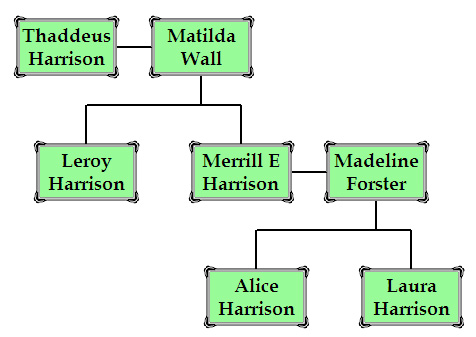
Who’s who?
Some reviewers of the novel suggested that a master Family Tree revealing all the book’s characters on one chart might have been beneficial. Au contraire! This action would have instantly removed a large portion of the book’s mystery elements which center around some key characters having family relationships which were not evident to outsiders looking in.
In a few instances, some family members themselves were deceived into accepting false relationships. As such, the evolving Family Tree becomes central to the tale, and explains some of the tragic happenings. This evolution of the truth also helps us to resolve the biggest mystery of the saga …. “Where’s Merrill?”
Back to More Merrill Musings
Try the WM? quiz:
Go on – it’s only a bit of fun.
If you’ve read “Where’s Merrill?“, then let’s see if you were paying attention.
If not, just guess – but at least one of the answers is on this blog.

*** Winter sunrise at Claddagh HQ ***

Fiddann River frozen solid Christmas 2010

The big Fiddann thaw after the big freeze

Where’s Shankley?
This Bengal cat knows the answer.
A Bengal pedigree hybrid cat is the fourth generation offspring resulting from breeding an Asian Snow Leopard with a domestic feline. These beautiful animals of gentle temperament retain the golden-spotted markings of a leopard on their underside, a tiger-like shiny striped coat and distinctive “mascara” markings around the eyes and face.

Back to More Merrill Musings
John James Cosgrove died last night, 20th March 2013. He was born in Leitrim in 1927,  and relocated to the south of County Sligo aged 20 in 1947. After a difficult start in life, he devoted his remaining days to helping the Sisters of Charity raise and teach unwanted children and orphans at Banada Convent. In return, they helped him to find a home and an identity in County Sligo. John James never married, but he loved traditional Irish music, a game of 25’s, and the craic. He also preserved the ancient Irish art of brewing a “fine drop” with the blessing of the fairies.
A while back, a local radio station visited his “local” to record the music and story-telling. John James was full of amusing stories from the auld days and he was asked to give a recitation to the listening audience. After a couple of refusals, and a couple of brandies, this is what he got up and recited to an enthralled audience:
It was a few days before the All-Ireland Football Final, way back in the 40’s and 50’s, when this lad from Tubbercurry decided he’d like to see the big game. All the trains and buses to Dublin were fully booked for a week in advance, so Paddy made a plan to cycle all the way to Croke Park. He set out in good time on the Thursday. He had a mate in Longford who put him up for the first night in a pub just outside the town. Then on the Friday he cycled all the way to Maynooth where he had a cousin in the seminary, training to be a priest. Paddy said a few prayers in the Maynooth chapel on Saturday, and then headed off to the big city for the big match the following day. He got digs with a nice family near the stadium, and he was all set for the Football Final after mass on Sunday.
Paddy had about four hours until the throw-in, so he ventured into a few pubs. The Sligo and Leitrim buses were pulling into town and the fun to be had was mighty. If all truth be told, he had a few too many pints of porter. Anyway, the pubs started to empty as the teams began to line out, and the lad from Tubber was carried along by the crowd heading for Hill 16. The game passed in a blur. It was a close game and it didn’t matter who won or lost. It was a thrill to be there, simple as that.
After Sam was awarded, all Paddy’s new friends headed back to the north Dublin pubs outside Croke Park. The lad from Tubber thought “I’ll just have a roam, and then find some more digs on the way home.” Well, he had one for the road, and then one or two more – and then he couldn’t remember where he’d left his trusty bike at a quarter to four. He was sure he last saw his bicycle outside a pub near Parnell Square, so he had a few more jars up the top end of O’Connell Street but the bike was not there.
As midnight approached, he searched the back alleys. Apart from courting couples trying to hide, the Sligo lad could find nothing to ride. Before he knew it, he was down by O’Connell Bridge. It was late, and cold, and he was hungry, and exhausted from his day out in the capital city. He saw a few vagrants laying out beds on the bridge’s wide parapets; they looked lost but okay. He grabbed some cardboard boxes, and down beside the tramps he lay.
Paddy must have dozed off because the next thing he knew, a big chauffeur-driven car pulled up by his pew. The rear door opened and a pretty blonde lady said, “Why are you sleeping here, when I have a bed?” Well the lad from Tubber woke with a start, and he climbed into the back of the wealthy lady’s cart.
As they drove through South Dublin, our laddo told his tale. The kindly lady said, “I’ve no bike, but I’ve got hot food and ale.” The chauffeur dropped them outside a big house, and he was welcomed inside. The blonde lady prepared him a hot bath, and a clean robe she did provide. She told him that she’d cook him a steak dinner to be washed down with cold beer. Paddy was in heaven, thinking “I’ve hit the jackpot here.“
After dinner, they danced and started to kiss. I’m nearly at the end now, if you’re needing to p …. pay a visit.
“Now Paddy,“ says she. “Go warm my bed up, whilst I powder my nose“. Without no more prompting, young Paddy lay his head on her pillows.
And then she appeared in a see-through negligee, and the boy from Tubber thought this really is my lucky day. “Move over” she said, as she climbed in the bed, giving our Paddy a peck on his forehead.
“Move over a bit more.“ The room span and he went all dizzy in a jiffy. And that’s when our Paddy … fell into the River Liffey.
County Sligo have never appeared in a Men’s All-Ireland Football Final in Dublin. Neither have John James’ native county of Leitrim. That’s what makes John James’ story-telling all the more ridiculous and charming.
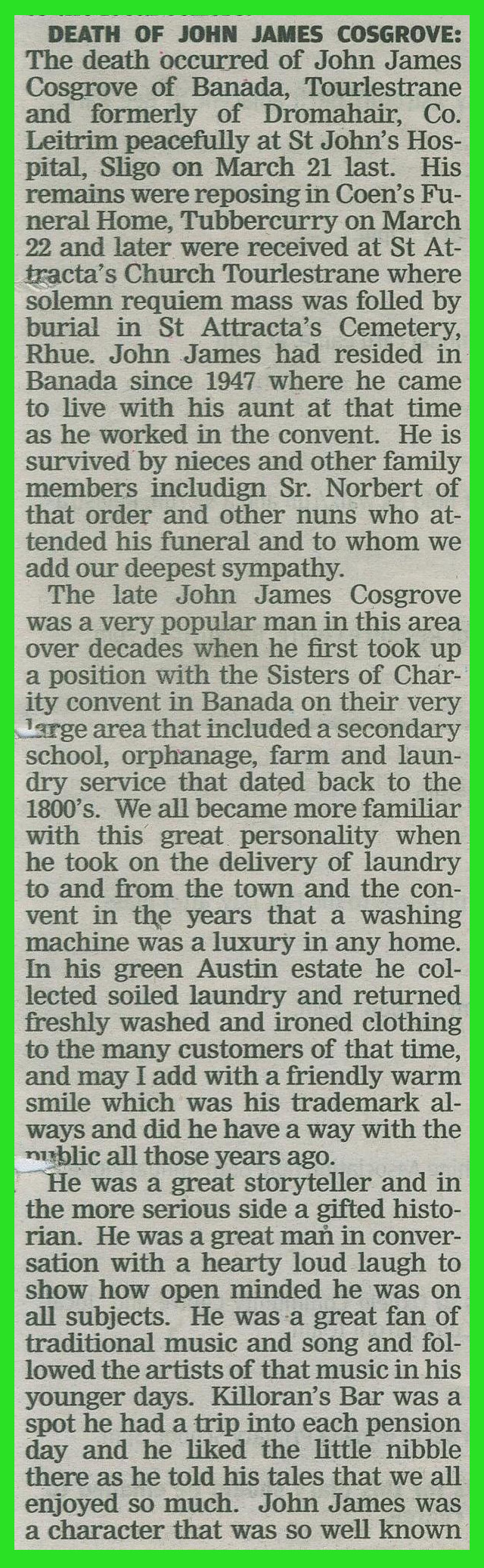
Obituary
A place frequented by Merrill; perhaps too frequently during the mid-1930’s.

Also, Merrill was in this court after courting Sabrina
THE MASON CITY COURTHOUSE
Back to More Merrill Musings
Loss is a small word but the cause of a massive array of overwhelming emotions. Loss of a loved one through natural death is hard enough to cope with, but losing someone unexpectedly because of an accident or criminal intervention multiplies every difficult emotion. What could be worse?
There is something worse which thousands of unfortunate people have to deal with every day. And for most of them, I mean “every day” of their lives. This is the utter devastation caused by losing someone suddenly when there isn’t even a corpse to grieve over. In fact, the sufferer does not know if there has been a death, and that is what makes this condition worse than anything. Each country around the world recognizes this topic as Missing Persons, and it is a tragic and bizarre phenomenon.
When you tot up the worldwide numbers, hundreds and hundreds of human beings, all belonging to families of one description or another, just VANISH every year from the planet.
Of course, as you start to interrogate the statistics, many missing persons’ cases begin to fall into possibly explainable categories … but the analysis still leaves many, many mysteries. Regardless, the “not knowing for sure” element torments the family relatives left behind in every case where the body or whereabouts of the missing person is never identified.
The “lost soul” could be a child or adult. The children’s category brings its own set of woes. A younger child would not deliberately run away from home, so the worst is feared. Having to imagine the end is more terrible than knowing a young life has perished for certain … but what if he or she was inexplicably abducted, and lives on? The pain of uncertainly is merciless.
When an adult disappears, the concerns are initially different. A mentally competent adult has the right to break contact with blood relatives or loved ones, if he or she so wishes. Police agencies will not investigate a missing person case until it has been established that some form of misadventure has caused the sudden loss. Thankfully, though, national agencies are starting to track and log all categories of reports involving missing persons so that the phenomenon can be better understood. The collated figures are mind-boggling, especially in the densely populated countries.
For example, in the USA, over 700,000 names per year are classed as “missing” at some point. That’s around 2,000 people per day being reported missing – after local searches! I was relieved to learn that the FBI can remove the vast majority of these American residents from their database as each temporarily missing person is traced. However, at any one time, about 48,000 Americans are being actively searched for to some extent.
We need to examine smaller numbers to really grasp the situation. In my own country of Ireland, with a modest population of circa 4.5 million in the Republic, it is reported that about 8,000 people per annum turn up on the Missing Persons register, for a while at least. Not including the rarer cases of missing young juveniles, that works out to reveal that 1 in every 500 resident Irish adults could be declared as “missing” – each year. When the voluntary runaways and the mentally vulnerable have been traced, we are still left with a few dozen folk who just vanish, year on year, on a comparatively small but civilized island. And the few dozen excludes “missing bodies” not recovered after a known catastrophe, such as fishermen lost at sea following a shipping disaster. This state of affairs is repeated around the world, on a much bigger scale. Put crudely, there are permanently Missing Persons everywhere. So, where do all these recognizable and often much-loved people disappear to?
A gruesome but converse section of national databases is sensibly being put together by the authorities in each country responsible for logging names and descriptions of Missing Persons [MP]. This is a growing worldwide register known as the MPUB index. The UB part stands for “unidentified bodies.” A strange twist to the MP phenomenon is that a worryingly high number of dead bodies remain unidentified around the globe, every year. Modern technology is finally allowing a few of the long-lost missing persons to be chalked off the statistics when a match is found in the UB section, somewhere. For some desperate families, peace of mind is granted and the natural grieving process can run its course.
It is a controversial subject as to whether the public at large should be allowed to view the growing UB database. I give advanced warning to anyone who comes across the accessible sections of the MPUB online to be prepared for some disturbing images. Viewing human corpses is a very unpleasant business for most of us delicate souls – but how else can tormented relatives complete the ultimate search for their particular MP? Advances in DNA technology are permitting family matches to be made to some UB’s. As you might imagine, visual recognition is impossible in many circumstances. The UK is taking the lead with this sensitive project. In Britain alone, over 1,100 dead bodies from the last 50 years are unidentified and therefore unclaimed. UB’s discovered as far back as the 1950’s are being exhumed from burial grounds to allow DNA testing samples to be taken. Believe me, it is better to know where your loved one rests rather than live a life in purgatory, if not Hell on Earth.
This subject matter came to my attention midway through my search for Merrill. He was an undeclared Missing Person, some time just before WW2. I started to weigh up all the options. What happened to a fairly well-known man about town? There was absolutely no evidence to support the theory of Merrill living in secret under an alias, until a natural death in old age. In fact, we unearthed one vital piece of paper which tells us that his life ended abruptly. As such, we knew the time and place of death within a rational envelope of accuracy, but we had no info about the circumstances.
Suicide in a remote wilderness was ruled out after I researched psychopathic tendencies. For about the last decade of his life, Merrill’s behavior matched the clinical definition of a psychopath on many counts. An undiscovered accidental death? Unlikely in the populated towns and cities which Merrill frequented. Sudden natural death? Only if Merrill was alone on a mountain top. Implausible. All these scenarios would normally lead to an eventual UB or John Doe of some description, even if it was just skeletal remains. Whilst the police authorities in Midwest America of the 1930’s did not have the modern advances in post-mortem science, they did circulate regular regional bulletins to notify other law offices and the general public about unclaimed corpses. The relatives of missing citizens would have been contacted after each grisly find. The disappearance of a high-flying businessman and family man would have remained in the public eye – had it been reported.
But all this becomes inconsequential. At least one person knew that Merrill was gone forever. My “Where’s Merrill?” novel exposes who this was. Nonetheless, the more intriguing aspect of Merrill’s demise is that it was not officially registered. To some, Merrill was gone. To others, he was a Missing Person. My job was to work out how many associates of Merrill fell into the first category. We did find evidence that more than one close associate knew more about the “end game” than they ever disclosed. That nugget of info has not been published … yet.
The coming together of those who worked on the “Where’s Merrill?” project resulted in a strange MP coincidence. Obviously, Tim had a Missing Person; a grandfather without even a name, at the start. The mystery surrounding Merrill’s unconfirmed resting place still niggles away at a grandson who never got the chance to meet his mother’s parents. But it was only by accident that the research team members realized that each was familiar with the never-ending despair of the MP syndrome. Kathy from the Midwest has a fondly-remembered relative who qualifies for inclusion on the discomforting MP database which every family should dread. As with all MP cases, personal circumstances suggest possibilities, but the nightmare of uncertainty consumes the MP’s nearest and dearest.
Sue and I have that associated hole in our hearts too. Without belittling the magnitude of human loss, the sudden disappearance of a pet animal evokes all the symptoms of MP anxiety in its own way. Many small pets are classed as full members of the household and when they’re not around one day, the whole ambiance of a family home is changed forever. We “lost” a much-loved pet on an ill-fated day and, despite endless and fruitless searches, the “not knowing” is a painful memory that is excruciatingly hard to subdue. A cruel consolation is that I can now empathize more fully with the suffering families of a missing soul of any description. As shown above, there are a lot of us around.
Of course, there are increased reasons for a roaming domestic animal not returning home. There are predators lurking everywhere, waiting for the right opportunity to pounce. In the quirky world of Gearoid O’Neary, my own heartache helped to answer that bothersome question, “Where’s Merrill?”
Back to More Merrill Musings
“Where’s Merrill?” is a uniquely crafted mystery thriller based upon real life historical events. In fact, it is two inter-related stories in one novel set in different time-frames namely the past and the present. An Irish genealogist called Jed is commissioned by Tim, an American client, who needs to understand more about his mysterious maternal ancestry. Fate had dictated that Tim never got the chance to meet his grandparents, and he didn’t even know the name of his mother’s father. She refused to tell Tim, even on her death bed. Why? That was a question which troubled Tim as he witnessed his mother’s melancholy throughout his adult life, and after her death he resolved to find some answers – and peace of mind.
It was also a question which intrigued Jed after he learned that Tim’s grandfather simply “disappeared”. No death record, no burial – nothing. Jed identifies the “missing” grandfather to be Merrill Harrison. Within weeks, Jed becomes obsessed with Merrill’s life, as he embarks on a personal crusade to find Merrill’s resting place. If he is to ever achieve his goal, Jed needs to fully understand the complex twists and turns linked to Merrill’s existence and apparent disappearance. As a result of his findings, the Irish researcher is led along a fascinating historical trail stretching back to the pioneering immigrants of Midwest US, through the following decades of social change in America and eventually all the way to the White House during WWII.
A web of worrying deceit woven by Tim’s ancestors is gradually unraveled. Once hidden family secrets are exposed. Jed turns from genealogist into cold case detective as he comes to the conclusion that multiple criminal misdeeds have been covered up … but where’s Merrill?
Back to More Merrill Musings
The research process to fully understand Merrill and his extended family lasted through most of 2011. During this time, the research “team” suffered one sad tragedy of their own. The father of our local Midwest research assistant, Kathy, died suddenly and unexpectedly. The project went on hold as all involved instantly recollected the real pain of losing a truly loved one. Family history researchers spend a fair amount of time retrieving and studying death records; some remain detached from their findings. Not us. Compassionate genealogists empathize with the feelings which their surviving research subjects went through when a close relative passed away. The death of Jack Haley made us all take stock of our lives, and say a few prayers of remembrance for the dearly departed whether they be our own ancestors or those of our research clients.

John E “Jack” Haley (1936-2011)
Obituary: Jack Haley lived what he loved: planes, trains and real estate.
He became a pilot after joining the Air Force in 1958 and continued to fly planes the rest of his life. During the Vietnam War, Haley completed more than 100 combat missions over the Ho Chi Minh Trail and was awarded the Distinguished Flying Cross.
He later spent six years flying first families — including Presidents Richard Nixon and Gerald R. Ford, on occasion — vice presidents, Cabinet members, senior military members and elected leaders. He also routinely flew Secretary of State Henry Kissinger and Gen. Omar Bradley. Jack Haley retired from the Air Force in 1978.
Haley began his real estate career while in the service, initially purchasing rental homes and small apartment communities. At the time of his passing, he owned 10,000 apartments in 10 states.
Always fascinated by railroads and an avid model railroader, he owned two railroad companies from 1984 to 1991 which formed an 850-mile stretch of railroad between Chicago and Omaha.
Kathy’s personal tribute:
It has been my privilege to have had my parents into adulthood. My parents witnessed the births of their grandchildren and great grandchildren, gave me pure unconditional love and shaped the woman I am and the mother I am to my children. I have been very blessed.July 2, while walking with my step mother on a beautiful summer morning, my father, suddenly feeling tired, sat down on the neighbors front lawn and quietly and peacefully died, and with the mercy of God, quickly. Despite his age, it was unexpected. I have lost a wonderful friend.Yesterday, we gave our final farewell and salute to Dad. He was buried with full military honors and a patriot guard escort. He was proud to be an Irish American. His friend flew over the cemetery with a fly over, nodding his Aerostar to the ground below three times. It was a beautiful tribute which Dad would have loved. He also loved God and his country. He loved his faith.Dad had ran marathons until he was 70, then he walked. He quit smoking over forty years ago. He had flight physicals, (more rigorous than the standard) and did everything in his power not to die of a heart attack, to live a long, healthy and productive life. But God had other plans. He had a faulty heart valve, a condition of age, nothing he could control. We believed he had years left, years remaining to share with him. Time. How ironic his certificate will list a heart attack as cause of death.Well “the old man” is in heaven now; smiling, maybe singing a favorite Irish song of the same name, and dancing with his own father, both watching the planes soar in the sky. With an old Irish Blessing, may God hold you in the palm of his hand.
Family history researchers can build up a realistic mental image of ancestors they never met if the ancestors in question featured now and again in local newspapers, and if these contemporary articles were preserved and can be found in newspaper archives. The news stories might just be local trivia, or you might get lucky and find tales of involvement in major incidents and even alleged crimes. The journalists of old had a tendency to describe the physical appearance of the persons being reported on, and sometimes these hacks would also arrogantly assess (in their biased opinion) the personality of the characters in a newsworthy story. The wealthy friends of the press of yesteryear were always fine, upstanding pillars of the community, and the common hard-working labourer was generally to be viewed with suspicion, regardless of his faultless life to date.
You can get even closer to a long-gone ancestor if you are fortunate enough to discover that your deceased relative made a Will prior to death. The retrieval of a probated Will can often reveal a list of the most valued personal effects of the person in question. You can also get a clear insight into which family members or friends of the deceased were truly respected, and maybe also those associates who were to be taught a lesson with derisory bequests.
In this regard, the research into the relatives within Merrill’s extended family unearthed several Wills which, in the main, simply confirmed the mental pictures we had built up of the more crucial characters. For instance, we know that Uncle Hubert Forster was a country sports fanatic from both newspaper articles and the fact that he left his prized fishing tackle and rifles to his nephew Horace. He also gave the younger generation of Forsters first refusal to take over ownership of a very trendy automobile (in its day), this being Hubert’s classy Pierce Arrow car. A photo of a surviving model is shown below. It is not beyond the realms of belief to imagine that a certain upwardly-mobile young businessman from Mason City might have taken a great interest in a valuable car going for a song.
As such, Hubert’s former car becomes the vehicle of choice in my novel for Merrill Harrison, the husband of Hubert’s niece.

A great car in which to race a Ford Model T
In a similar but much more poignant vein, we also discovered through Wills that the ladies in the Forster clan had a love of Hudson Seal fur coats and accessories. Whilst these fashion items are not so politically-correct these days, an expensive fur coat would have been treasured in the early decades of the 20th century. When the owner of a Hudson Seal Coat passed on, you can be sure that their fur coat passed on too, usually as a bequest to a favourite younger female relative. It was only when we studied again the beautiful portrait photo of Merrill’s young wife, Madeline Forster, that we realized that she was wrapped in an elegant fur stole – perhaps one of the very same Hudson Seal creations mentioned in her relatives’ Wills.
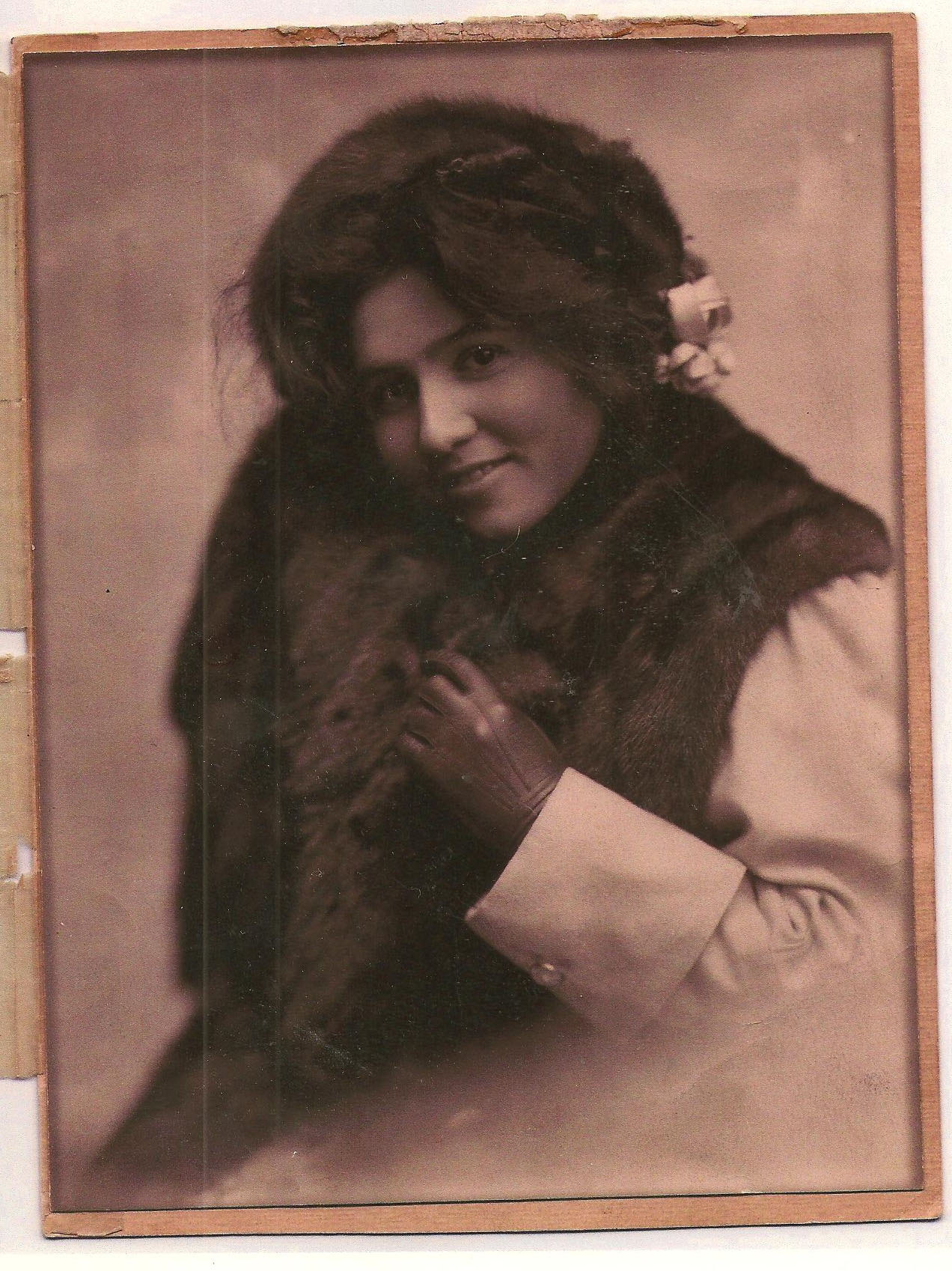
Madeline Forster in fur
We hope that Madeline’s daughters also got the chance to parade around in fur for a while, later on, as unbeknownst to them, Merrill was chaotically frittering away family finances, chasing his own selfish dreams of eternal wealth.
Back to More Merrill Musings
The prologue of Where’s Merrill makes reference to the fact that I wrote large portions of the novel with a certain piece of music playing in my head. This was the rather unique instrumental titled Music For A Found Harmonium, and a link to the original and most fascinating rendition of this tune by The Penquin Café Orchestra is provided below. This piece of music was composed by the co-founder of the experimental orchestra, namely Simon Jeffes. Appropriately enough, the story behind the composition is that Simon found a harmonium whilst on tour in the Far East and sent it to a friend’s house in Kyoto. When he later visited his friend and his “found harmonium”, he was inspired to write an unforgettable yet simply structured composition which suited the quirkiness of the instrument.
In turn, Jeffes’ relentless harmonium tune inspired me to put into print the passages which describe the research processes used by modern genealogists … and the confusion and/or excitement generated by first discovering a new fact which forms part of a much larger multi-dimensional puzzle.
Music For A Found Harmonium has been compared in style to a traditional Irish reel. Indeed, many talented Irish musicians have recorded or performed their own take on the composition. Check out Sharon Shannon’s version, for example, if you would like to hear a more up-tempo, foot-tapping rendition. I have no doubt this association is the reason why the tune became my overriding theme song for Where’s Merrill because the novel jumps back and forth between present-day Ireland and often hectic goings-on in Midwest America of yesteryear, especially near the end as Merrill himself jumps from place to place. Music For A Found Harmonium can be played on any instrument, at any tempo, but the resultant output always evokes images of normality being turned on its head, and then the temporary mayhem being restored after a while – in my opinion. The music also seems to fit the diverse locations and eras in which the book’s main characters, Jed and Merrill, dwell.
I don’t know how other authors work, but during the writing of Where’s Merrill, I found myself getting into a routine wherein I would naturally wake up early in the morning, between 4 and 5am, with a multitude of ideas buzzing around my brain. I would then sit in silence in the dawn light with just hot coffee for company as I scribbled down a few scene-setting notes. And then as I expanded each passage of the complicated story, I found myself subconsciously writing to music. I was not playing the radio or any other physical music-playing device. The tunes just jumped involuntarily into my mind as I focused on each developing scene. Before long, I had a complete soundtrack in my head covering the whole novel. I could jump from scene to scene, and mood to mood, by simply recollecting each inspirational piece of music.
I can only think that I was influenced by modern film-making techniques which sometimes use completely random background music to emphasize key moments in movies. It does not seem to matter anymore if the film director’s choice of music is historically or chronologically out of sequence with the action being portrayed. It is the “mood” or sentiments of the musical pieces which matter more than period appropriateness. In effect, I eventually realized that I was not really creating a story in “black and white,” in the conventional style of a creative writer. On the contrary, I was writing down, as quickly as possible, my description of a colorful movie being shot on location in my head.
There are other references in the Where’s Merrill novel to musical accompaniment. Early on, Jed’s sidekick and faithful partner, Sue, tells him that his ultimate research quest is like looking for a “Needle In A Haystack” and they sing along to this classic 60’s pop song by The Velvelettes. At this point in the story, Jed is upbeat and enjoying the developing search for Merrill, so a fun song is quite fitting.
In a similar vein but with darker undertones, there is a reference to another hit record from the “Swinging Sixties“. This occurs when a Swing Band from the 1930’s plays a number to which the young dancers sing out loud the chorus, i.e. “they seek him here, they seek him there,” etc. The song influencing my thoughts at this point was Dedicated Follower Of Fashion by The Kinks which itself was influenced by music heard in earlier generations in the Dance Hall era. At the time of the song’s release in 1966, the composer, Ray Davies, was lampooning both the London fashion scene as well as the type of music his parents used to enjoy. Whilst the original lyrics do not sit well with the antics of Merrill Harrison in the 1930’s, I did find myself changing the title line to “Dedicated Follower Of Finance” when thinking about our anti-hero and his tendency to turn up in unexpected locations.
I found that writing passages set around weddings and funerals with their church connections to be relatively straightforward in the context of my spontaneous musical play-list stimulation. We have all heard very moving music played at church services, even though we often haven’t got a clue what the pieces being performed are called, and maybe even less so, who composed them. Many of the most memorable pieces of church music were written centuries ago by classical composers such as Bach, Handel and Purcell. This pedigree of musical maestros used to claim that church compositions were just simple tunes created almost as a whim, and that is why we probably retain these moody melodies somewhere deep inside our consciousness. They were the pop singles of days gone by, and the more complex album tracks were only played in the theatres and opera houses. The composition that came back to me instantaneously one bright summer’s morning was the once-lost Canon In D by the German composer, Pachelbel. It is strange to think that this now instantly recognizable tune was tossed aside as a bit of lightweight fun and not played for about 200 years. The fact that it was lost, then found (like Jeffes’ harmonium), seems to have some perfect irony when I link Canon In D to my search for Merrill.
I once heard Canon In D played “live”, many years ago, by a talented chamber quartet who were busking (of all things) on a Dublin shopping street. Back then, I didn’t know what the piece was called. I thought to myself, “Where have I heard that before?” A mental image of a church, and then a wedding, popped into my mind. I couldn’t recall a specific wedding I attended where it was played – but now the Canon In D and weddings seem to be forever intertwined. In hindsight, my resourceful mind was being quite logical when it decided that Madeline Forster should walk up the aisle to Merrill to the advanced strains of Pachelbel’s delayed pop song.
I have got to admit that I struggled to find the right background music to accompany the closing sequences of Where’s Merrill. I reckon that the reason was twofold. Firstly, the scenes and dialogue had to describe sinister events and the majority of my mentally-retained musical repertoire is of an uplifting nature. Secondly, I initially did not know the precise details of how Where’s Merrill ends because there was no corresponding text in my research notes to guide me. So, how could the brain cells in charge of associated memory-recall link something musical to passages which were not fully defined?
I am a believer in fate, and that’s how my writing dilemma was resolved – not for the only time during this adventure. I went for a short, late morning drive in my car and turned on the car radio. I normally listen to a station dedicated to 24/7 news; all chat and nothing else. So how come it was playing the opening chords of a very vaguely familiar pop record? I turned up the volume trying to work out what was being played. The chords struck a chord, and the initially jolly tone of the song became shadowy and eventually threatening enough to suit the “end of Merrill.” I started to listen to the lyrics, and they matched the murky mood as well. It was probably the first time that I had re-heard the particular song on the radio in over 20 years. The radio presenter never did explain why he was playing a peculiar old pop tune in an interlude between “deep” discussions on current affairs. Fate.
The radio song was Skin Deep by The Stranglers, a perhaps under-rated group of talented musicians who hid behind their self-created image as the intimidating Men In Black. My fateful hearing of the song helped me over the finishing line and the main body of the novel took its final shape. The closing chapters of Where’s Merrill see multiple characters acting deceitfully, some even pretending to be completely different individuals. Watch out for the skin deep. The Velvelettes never warned that sometimes it’s tougher to look than to leap when we started looking for that Needle In A Haystack.
Many people tell you that they’re your friend
Believe them, you need them for what’s round the river bend
Make sure that you’re receiving the signals they send
‘Cause brother, you’ve only got two hands to lendMaybe there’s someone who makes you weep
And some nights they loom up ahead when you’re asleep
Sometimes, there’s things on your mind, you should keep
Sometimes, it’s tougher to look than to leapBetter watch out for the skin deep
Better watch out for the skin deep
Watch out for the skin deep
Watch out for the skin deep
Better watch out for the skin deepOne day the track that you’re climbing gets steep
Your emotions are frayed, and your nerves are starting to creepJust remember the days as long as the time that you keep
Brother you better watch out for the skin deep
The timely intervention of The Stranglers also led me to listen again to my favourite composition by this band, the eerie but entertaining instrumental titled Waltzinblack. I now retrospectively attach this scary waltz to my vision of Mame Novak dancing all over the best endeavours of poor Horace as he attempted to keep the financial affairs of incarcerated “Aunt Edith” in proper order.
Other pieces of music played their part during the conception and delivery of Where’s Merrill, but two songs from the same genre crept into my head during the laborious proof-reading and pre-publishing phase. Strangely, without knowing it at the time, both of these songs produced in the familiar American Country Music style turned out to have been written by Europeans in the mid 1970‘s. I have written a separate post about one of these two songs, a country lament which I now call the Merrill & Sabrina Love Theme.
The other song was actually a record I grew to loathe when it hit the Number One spot in the pop music charts in 1976. I am referring to Mississippi by Pussycat, (apparently) a Dutch band led by three sisters. The song got so over-played, and usually with the same badly-mimed video backing, that a catchy ditty turned into parody of itself within one month, to be only ever heard again on Golden Oldie radio shows decades later. But as I finally published my Where’s Merrill novel after months of toil, an overwhelming sense of relief engulfed me – and the first song I randomly heard on a TV music channel that evening was a “new” (to me) and “live” version of Mississippi complete with full orchestral backing. Fate? It sounded wonderful, and I just sang along, and laughed and danced, and laughed some more. I had got to the final end credits of the movie in my head.
If you read Where’s Merrill, then you might appreciate the absurdity of Merrill’s researcher singing about the Mississippi just “rollin’ along until the end of time.” The search for Merrill might never end, and the empathy for many of his tragic extended family members might never go away – but Merrill’s grandson and I have learned that life must go on, and we can sing and dance when the mood takes us.
Back to More Merrill Musings
Hughie insisted that there was “two L’s in Tullinaglug.”
Morris retorted that he should look at the old maps. “There’s definitely three L’s in Tullinaglug.”
“Bollix!” shouted Hughie. “There’s Molly Moran’s well, and there’s Neary’s well. Behind the cottage, by the cow shed.”
There’s no answer to that. It’s true.

The well’s round the back
In our search for Merrill, we traced the lives of all his possible associates. This meant researching the whereabouts of all identifiable members of Merrill’s complicated extended family. In doing so, we came across one very eccentric character called Andrew Hessler who led a fascinating life with echoes of the Mystery of Merrill, although this man’s antics occurred a few decades earlier and culminated with his shocking death in 1915. As a result of my strange findings, I christened Andrew as Mini-Merrill.
If you‘ve read Where‘s Merrill, you will recall that Horace Forster’s mother was Amelia, and when her husband Leo Forster Jr shot his brains out after five years of marriage in 1886, we found out that Amelia eventually got married again to this fellow called Andrew Hessler – but this second husband “disappeared” (just like Merrill) during 1900 amid rumours of suicide.
I take some comfort regarding my ultimately frustrating search for Merrill’s whereabouts after 1936 in that I was able to track Andrew down across several far-flung American states after his particular reported “disappearance“ in 1900. Here’s a summary of Andrew Hessler’s crazy life:
It is clear that Andrew could never settle down in one place. This tells us something about his personality, perhaps reflecting a character akin to Merrill in later life. Thankfully, newspaper reports provide more than just hints of what was going on. It is apparent that Andrew was considered as the equivalent of a musical pop-star of his generation, and reaped the financial benefits. In each city where he lived for a while or more commonly visited “on tour“, he organized sell-out musical shows. Andrew gained the support of town dignitaries by offering to make charitable cash donations to local worthwhile causes, agreeing to meet the unaware benefactors at noon on the day after his recitals. It seems like Andrew was regularly trusted to act as banker of the concert takings at his overnight hotel – but Andrew was always long gone after a hearty breakfast and probably beyond State borders by noon the next day.
When his voice started to fail, he turned his hand to the management and sales of saloon bars. More opportunities for some dodgy dealing. As with Merrill post-1923, it is also clear that Andrew sought out wealthy brides to help him to finance his lifestyle. It’s my bet that Hessler “disappeared” in 1900 with his own chunk of the growing Forster Fortune. The Will of Catherine Rausch is an amusing “classic”. What better way to shame a dastardly husband? Referencing Andrew, this is what she had calculatingly had written up and witnessed:
To the individual who married me in San Diego, California, and who got from me thousands of dollars and when he could get no more, deserted me, I give one dollar payable in monthly installments of 25 cents.
The newspaper hacks in 1908 reported that “Hessler’s present whereabouts are unknown“ (again!) but I found him – again.
And the whole tale came full circle when I finally found Andrew’s funeral notice and brief obituary. It mentions his stepson Horace. Bizarrely, it seems that Andrew kept in touch with Horace from a distance, or at least made his late-life friends aware that he had a stepson. Imagine how Horace must have felt upon hearing the news from San Diego about Hessler’s dramatic suicide; both his biological father and stepfather had now raised a pistol to their own temple – and pulled the trigger – albeit 30 years apart.
Andrew’s obituary concludes by stating that “in recent years, Hessler was financially embarrassed.” This statement also resonates with our main missing man, Merrill, except I believe that Merrill learned how to hide that embarrassment by adopting the persona of an always comfortably well-off businessman … and then conning foolish associates into investing in his dubious schemes. In the end, Merrill was showing classic psychopathic tendencies, and psychiatrists tell us that extreme psychopaths cope with life by believing in their own deceptions as though it were true.
Medical experts also tell us something else: psychopaths do NOT commit suicide.
Back to More Merrill Musings
If asked to name some places where the infamous American mobsters of the 1930’s plied their illegal trades, most people would probably refer to New York and Chicago – and they would be quite correct because these great cities have been used as the glamorous backdrops for many gangster movies and stories featuring real-life criminals from that era. However, one US city is rarely mentioned when tales of crime capers of old are regurgitated for our general entertainment. Perhaps understandably, until quite recently, the current governors of this particular city preferred “no publicity” on this score, in order to attract new investment and to maintain its new-found clean environment. This city is St Paul in Minnesota, arguably the most dangerous metropolitan area in America in the 1930’s, and which just happened to be one of the last places on earth to where the elusive Merrill Harrison can be traced in this decade. The liberal-minded modern citizens of St Paul are now proud to boast that they live in the former “Poison Spot of American Crime”, a tagline created by leading politicians from New York City in the Depression era – and these guys had gang leaders Lucky Luciano and Bugsy Siegel on their own doorstep.
If you think that my description of St Paul back then is exaggerated, then consider some of the names who were known to frequent the city at the same time as our Merrill. You will have heard mention of some of these scary characters before, but you don’t have to be an expert in historical crime to figure out that this lot were an unpleasant bunch just by reference to applied monikers. The list of outlaws includes Machine Gun Kelly, Creepy Karpis, Babyface Nelson, John Jackrabbit Dillinger and of course Ma Barker, who (some say) was the meanest of them all and the mother of the four Barker Boys, a whole new generation of hoodlums. A fair chunk of the FBI’s Most Wanted list of Public Enemies chose to make St Paul their home.
It was the formation of the illustrious Barker-Karpis Gang in the side streets of St Paul which provides one verifiable link between Merrill and the mobsters in the native city of his first wife. You could argue that it’s a tenuous association, but it is a connection to a shady underworld nonetheless. We know that Merrill was related to wealthy “Aunt Edith” Forster through his first marriage, and we discovered that Edith’s last residence was 671 Greenbrier Street in St Paul. During the grim 1930’s, this address featured in an audacious crime which sent headlines around the nation.

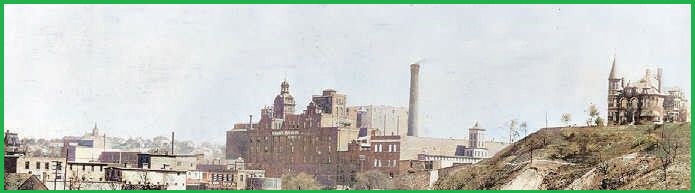
Hamm’s Brewery in St Paul
In the summer of 1933, William Hamm Jr, the multi-millionaire heir to the city’s Hamm Brewery empire, was coolly kidnapped in broad daylight as he strolled between his workplace and his mansion home, the big house on the hill with the formal address of 671 Cable Avenue, later re-assigned as 671 Greenbrier Street. Creepy Karpis was driving the car into which Hamm was shoved, and Dock Barker placed a pillow-case over the victim’s head as he politely asked Hamm to lie down on the floorboards of the gang’s Hudson automobile. A day later, a brewery manager received a ransom demand of $100,000 for William Hamm’s safe return. The corrupt police chiefs of St Paul were slow to react, and the Hamm family sorted things out for themselves. The brewery boss was back home in his hilltop mansion four days later, and the Barker-Karpis Gang were a hundred grand richer.
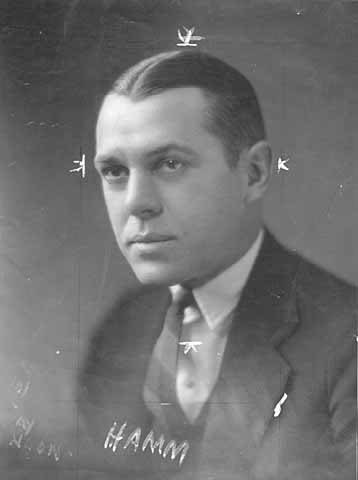
William Hamm Jr
Speculative arrests of small-time crooks were made, but each villain was acquitted due to lack of evidence of involvement in the kidnapping. The Hamm caper must have been considered so successful that Ma Barker’s boys outrageously repeated the crime six months later. This time they nabbed a millionaire banker named Bremer who belonged to the wealthiest family in St Paul. Through his father’s marriage, Bremer also happened to be in the Schmidt dynasty of local industrial brewing giants. Again the police stood back, and the kidnappers were always curiously one step ahead of the Schmidt family’s private investigators. Another cleverly-planned handover of cash reportedly swelled the coffers of the Barker-Karpis Gang to around $3 million, gathered in little over two years during the mid-1930’s. Perhaps they were trying to outdo their bank-robbing pal and often fellow-citizen John Dillinger who violently “withdrew” over half a million dollars from Midwest banks almost single-handedly, during the very same era.
The lawlessness of St Paul at this time even attracted the considerable wrath of President Roosevelt. His personal friends were being kidnapped and the law enforcers appeared helpless. It took a while before the FBI detected that the high-ranking police officers of St Paul had enormous bank balances which could not be justified from their salaries alone.
So – this was the scene at a time when Merrill was in a big financial mess, and dodging around the Twin Cities of Minnesota. We know for certain that the gangsters knew exactly where the thrifty offspring of German immigrants, like the Forsters, lived and worked in St Paul, and we know that they knew how to extort money from these ultra-wealthy families. And research indicates that before 1940, the Hamms from Greenbrier Street vacated their eerie mansion overlooking the brewery with all its bad memories, and for reasons not fully understood a certain “insane” Aunt Edith then takes up residence at this landmark house. The surviving Forsters must have been acquainted with the socially-elite Hamms, and probably the Schmidt and Bremer families too.
The Hamm mansion was destroyed in a fire in 1954, but Aunt Edith’s tragic life of isolation had ended three years earlier. Why did she live in the reputedly haunted house on the hill? Was it a nursing home, or a high-class prison for Aunt Edith?
Maybe a local historian can help answer these questions. All information welcomed.
More info about St Paul in the 1920’s and 1930’s is attached here in this excellent article by Paul Maccabee: St Paul Gangsters
And here’s a typical US newspaper front page from 1933 reporting on events in a faraway Midwest city which was rapidly gaining the reputation of becoming America’s “major” crime capital: 1933 Hamm kidnapping
Back to More Merrill Musings
I thought long and hard whether I could classify the Where’s Merrill? saga by the commonly used phrase “based on a true story.” Then I started to question the accepted definitions of the word “true”. Simple defining statements such as “not false” or “real” are inadequate, and possibly misleading in certain contexts. The truth is something that is understood to be true, so we should start to define “true” with terms like “a condition believed to be not false.” After reflecting on the findings of this unique research project, I realized that it had become a study of perceived truth. This story proves that some people can deceive their associates and even their family members by twisting the truth so convincingly that the deception is rarely challenged, and, with the passing of time, the falsified facts can become accepted as gospel. This topic is thought-provoking and potentially very worrying. Is your close colleague really the person he or she claims to be?
I then started to think about the crucial last two words of that casually constructed phrase “based on a true story“. What genuinely constitutes a true story? In order to analyze that question, one has to break down the phrase even further; so firstly, the noun part – what is a story?
My personal definition of a story is a narrative, written or spoken, that links together certain facts or events. This is not a contentious definition. The facts or events in question could be any ridiculous things which start to make more sense when linked together. However, if we prefix “story” with the key adjective “true”, then the fact or series of facts being narrated should be justifiable beyond all doubt to be reliable, real information, as far as the narrator is concerned. The listener or reader of the true story has a different dilemma. As a receiver of information, you, as a reader or listener, are left to make the distinction between a 100% true story, and a story based on the truth, or otherwise. It is a matter of perception and belief.
Let me give you an example which links back to how we perceive the people we associate with in our everyday lives. You might have a workmate, and you know (for certain) the following true facts:
Your friend says, “It’s my son’s first birthday tomorrow.” This alone is a very short true story. If your friend adds, “We’re having a party at my mother’s house. Her boyfriend is picking us up in his new car at 3pm,” then you might be being asked to accept a story based upon the truth. It would not be unreasonable for a first birthday party to be held at the grandmother’s house. Then again, if you had never met your friend’s mother, you are being asked to digest a lot of facts that you will never be able to prove or disprove at that moment in time. In the latter case, you would probably never have known that your friend’s mother was unmarried, and had a boyfriend. As for the bit about the “new car,” well, this could be a complete fabrication. Fiction. The friend could just be implying that her poor mom is doing alright for herself and has a rich boyfriend. Or, the car could be a newly purchased second-hand model. Maybe there isn’t even a party? How can you be sure? There are lots of optional interpretations.
But this hypothetical tale is all correct, in your mind. You trust your friend. So you believe that you have just listened to an expanded true story. In reality, you should be saying that you have listened to a story based upon the truth; a little bit of it might even be fiction. Get the gist?
My ‘birthday boy’ story is just trivial workplace chatter, but each day receivers of information from associates or the media are forced to make instantaneous decisions as to whether they are being told the truth. Invariably, we never question the information being subconsciously absorbed by our brains. As a result, it becomes accepted “fact“. Normally, this acceptance of all manner of subject matter has very little significance, but occasionally the consequences could be more serious, or even catastrophic. Several of Tim’s ancestors certainly had to deal with consequential catastrophes initiated by untruthfulness.
So, Where’s Merrill? has to be classed as a story based upon the truth, but as I said at the beginning, it is predominantly a story about genealogy—the tracing of one man’s lineage and a study of the associated families throughout history. The latter phrase is unquestionably true, but trusting and accepting that everything presented to you, orally or in writing, is undeniably true, just because it appears authentic, can create a potentially perilous state of affairs.
In a popular novel, the fictional detective, Nero Wolfe, once uttered the words, “You are so engrossed in the fact that you are oblivious to its environment.” This situation is all too common among amateur genealogists. A record provides evidence of fact, and we get so focused on the one piece of evidence that we fail to examine the context of it. This can throw off the conclusions we take from the evidence. When looking at any individual record, it is important to consider not only the information included, but the record itself. We must ask ourselves:
· Who created the record?
· Who provided the information recorded?
· Do we know when it was created?
· Is it the original document, or an original copy? Or something else?
· Are we certain of the answers to any of the above?
I was repeatedly forced to ask these questions when I dug deeper into the complicated hidden maternal ancestry of Tim. In effect, the Where’s Merrill? story revolves around a number of interlinked hidden truths.
One thing is undeniable: Where’s Merrill? is unique. I suppose you can argue that every story in the world is different, so all stories are unique to some degree. Even my hypothetical short tale about a child’s first birthday at the start of this passage is unique. However, this thriller is more unique, although such a term is grammatically unacceptable to linguistic purists.
Now that you have read the story, you are free to inquire how much is true by asking specific questions, if you so wish. Relevant (but disguised) public records can be made available to interested parties. As with a 100% factual book, you can complete the read and then refer to additional (but controlled) information sources to further your knowledge of the subject matter.
In this case, because it’s a story based heavily on the truth, you could propose or even eventually prove an alternative answer to that elusive question: Where’s Merrill?
Back to More Merrill Musings
This is the working title of my next novel.
More info and imagery to follow ….
There are returns available for 26 counties, and some of these returns are incomplete. It is thought that these figures were compiled by surveyors working for Sir William Petty, Surveyor-General of Ireland, who mapped confiscated lands from 1655 to 1659. The returns indicate the number of people living in each townland, and whether they were native Irish or of English origin.
Figures for the parish of Kilmacteigue:
224 6 230


The Hamm Mansion in all its glory.

After the fire.
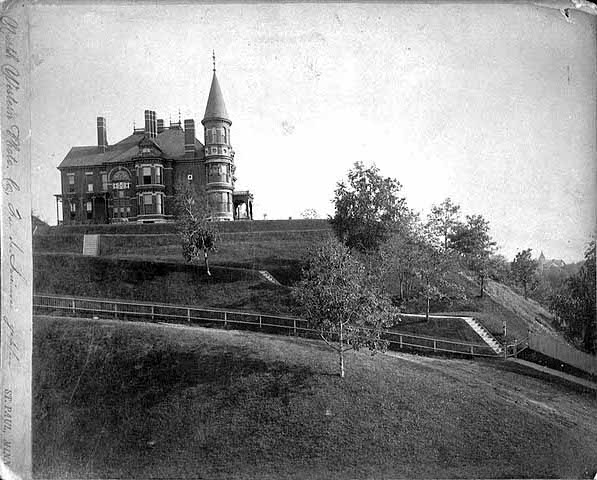
The creepy house on the hill, overlooking the Saintly City.
Back to More Merrill Musings
The e-book version of Where’s Merrill? [A Genealogical Thriller] was published on 28th February 2013 and subsequently released in paperback during 2014. It is available to purchase for just a few dollars from:
© AMAZON or
© LULU or

#1 AMAZON Best-Seller 2014
Go on …. read it and try to help solve some lingering mysteries
Stranger In The House by Elvis Costello, here dueting with the wonderful George “No Show” Jones.
This never was one of the great romances
But I thought you’d always have those young girl’s eyes
But now they look in tired and bitter glances
At the ghost of a man who walks ’round in my disguise
I get the feeling that I don’t belong here
But there’s no welcome in the window anyway
And I look down for a number on my keychain
‘Cause it feels more like a hotel everydayThere’s a stranger in the house; nobody’s seen his face
But everybody says he’s taken my place
There’s a stranger in the house no one will ever see
But everybody says he looks like meAnd now you say you’ve got no expectations
But I know you also miss those carefree days
And for all the angry words that passed between us
You still don’t understand me when I sayThere’s a stranger in the house; nobody’s seen his face
But everybody says he’s taken my place
There’s a stranger in the house no one will ever see
But everybody says he looks like me
Fans of Elvis Costello have often debated what the lyrics of this curious song mean. When first heard, the casual listener might think that it’s just another plaintive Country song about a guy who has lost his lover to another man. But then you delve deeper, and it’s something else.
First off, the song was written by an Englishman from an Irish ancestral family. Elvis Costello was born as Declan Patrick McManus but took his stage name from the King of Rock ‘n’ Roll plus the maiden name of an Irish great-grandmother. He was born in London and raised on Merseyside, near the Liverpool homes of The Beatles. Secondly, Stranger In The House was written circa 1976 and first released in 1978 by Elvis Costello, an artist who at this time had come to prominence on the popularity of the British Punk Rock / New Wave scene. Costello manipulated the musical mood of the late Seventies with tracks like the brute-force “Pump It Up” and the clever and poetically majestic “Oliver’s Army”. The latter hit single hinted that Declan McManus was not just a thrash metal merchant. Costello went on to dabble successfully in all musical genres, collaborating with established stars from the world of Pop, Rock, Jazz & Blues through to Classical.
So this partly explains why Costello passes through Nashville writing and performing Country Music songs which the likes of George Jones gratefully covered. The story goes that Costello developed a love of slower ballads and sad country songs as a youngster listening to his father, Ross, a moderately successful vocalist fronting old-styled Big Bands. Somewhat unfairly, the biggest claim to fame of Ross McManus is that he was the memorable voice of the hit TV commercial “I’m A Secret Lemonade Drinker” – yes, R Whites! Family connections got the then unknown Elvis (Jnr) a welcome appearance in the TV ad campaign, but around this time, at about age 21, young Declan must have penned his mysterious ditty, Stranger In The House.
To me, the song is not about a rival lover. On the contrary, it is about a man trapped in a love affair who is unable to reveal his true self. This man has kept to himself so many profound secrets that he no longer recognizes his original personality. As he continues and extends his web of deceit, his faithful partner is also feeling the strain of maintaining a loving relationship. How did a 21 year-old dream up this intense domestic scene and then manage to convey it in song in just a few short lines? Not many people know of such a man, do they?
And then I wrote the novel Where’s Merrill …. and then I heard the haunting song Stranger In The House again. I played it over and over again one night. It seemed to me that I had just “met” the lonesome lover in the song. His name is Merrill, and I subtitled the piece as “Merrill & Sabrina’s Love Theme“.
Back to More Merrill Musings
Former parish Priest’s Death:
The death took place after a long illness at Árd na Gréine Nursing Home, Enniscrone, of Conor Liam Cawley, retired parish priest of Charlestown. His remains were removed to St James’s Church, Charlestown, and his burial mass took place in church grounds. He is survived by his brothers xxxxxx and xxxxx, his sister xxxxxx, brother-in-law xxxxx and sisters-in-law xxxxxx and xxx, nephews, nieces and friends. The late Conor Cawley was parish priest in Charlestown for a number of years until his illness and retirement. He did much good work in the parish and was hugely involved in the big renovation work of St James’s Church. Sincere sympathies are tendered to the bereaved.
This “man” was a relative of mine. You cannot choose your relatives or ancestors. This bland obituary hides the criminal allegations laid against Fr Cawley long before his death. In Ireland of old, The State and Judiciary were loathe to prosecute the fine, upstanding men who served as Roman Catholic ministers especially if they were “sick”. In the locality, Father Cawley was renowned for his indiscretions, of a sexual nature. Employed as a schoolteacher, alarm bells should have rang out loudly. Nothing was said. As a consequence, Fr Cawley was promoted to Canon, so he continued to enjoy swimming with the nuns and the orphan girls.
Whilst my distant cousin rotted away in Enniscrone, attended to by dedicated nursing staff, one of his victims of childhood abuse could no longer live with the scars of being disbelieved. She committed suicide. Again – nothing was said.
No prosecution was ever forthcoming from the Garda Síochána; the guardians of the proud Irish Republic.
Today is Pension Day again. A day of great excitement in the parish. All the old folks are flushed with Euros, and the taverns are a-jumping. Well, they are until about 6pm when the OAP’s need a lie-down.
Friday is also Bin Day – my particular highlight of the week. To see a big truck on our single-track lane is quite exciting, only beaten by Nathy’s heating oil tanker which (thankfully) calls less frequently – especially if it’s the 6,000 gallon monster, totally unsuitable for South Sligo’s winding farm tracks.
Our local arrangement, trash-wise, is that we have alternate collection weeks for our two types of waste produce; domestic rubbish and recyclables. Today is recyclable rubbish day which is called The Green Bin Day – and that means putting out the blue wheelie bin. And of course, next Friday is a Black Bin Day for the landfill stuff, and that means we must all put out our green-coloured bins. Only in Ireland could such a simple and memorable system have been developed.
Dividing waste up into landfill and recyclable is a fairly new exercise in the west of Ireland. I often wonder if the local licensed waste carriers are as regimented as our old Bin Wagon service was over in Dublin. Over in the capital city, the Bin Man called every week to empty not one but three separate wheelie bins containing trash carefully divided up by each householder. There was landfill domestic, recyclables and also garden waste. However, I noticed that, each week, our Dublin bin man simply emptied all three bins into the same compartment at the rear of his huge truck. Having observed this, one time (after a house party) I placed some empty bottles into the garden waste bin. Later on in the week I was reprimanded by our conscientious bin man with an East European accent: “No bottle in garden,” he lectured.
“Just this once, please,” I pleaded. He reluctantly agreed, and then tossed the contents of all three bins into the landfill crusher of his shiny wagon. I waved him off, vowing to never break the (environ)mental rules again.
Compared to the chill of the Galician mountains, the west of Ireland has been unseasonably warm and dry. About time too – and perfect for the weekend Festival festivities.
I bet you are dying to know what happened on Sat & Sun [wot d’ya mean, no?], and I wish I could tell you. It wasn’t just the Friday night introduction of Blur, it was the onset of exhaustion which put me out of action for a while. I just couldn’t raise myself from the couch on Saturday evening, especially after Blackburn Rovers conceded yet another late equaliser.
Apparently you cannot play “live” music for 24 hours non-stop during a weekend festival. There has to be a minimum one hour’s break, for some daft reason. So Friday officially ended at 6am – and Saturday’s session started at 7am. Considering that Tony Marren led the opening musical ensemble at 10pm on Friday night, we must congratulate him that he also closed the Day 1 show only a few minutes past six o’clock the following morning. Then the musicians had a drink.
I was informed that Saturday saw a conveyor-belt load of renowned Irish trad music stars for the unplugged section of the festival. The tin whistles started dead on 7am, and rarely stopped during the next 24 hours. In fact, I’m told that some fiddling went on beyond the 6am Sunday morning curfew. It was gone seven o’clock when the last diddly-dee-er passed out. Hughie told me that he was very annoyed when he went down to the village on his tractor, a little earlier than normal, for his pre-Mass Sunday morning pint, only to find the Cock locked up. He said he could see about a dozen prostrate bodies through the frosted glass of the main bar-room window – but they were well out of it. No-one answered his desperate calls to “open the shop”. He told me that it was nearly “chihuahuas!” before the first corpse returned to life. Lazarus gave him a pint of Guinness, and then went back to sleep on the bar top.
I had stopped in, recovering in front of the TV on Saturday evening. Good decision. A respectable Sligo family were on Family Fortunes up against some Dublin gangsters. Mincin’ Alan’s first tough question: “Name something you’d find in a newsagents?” The Sligo captain jumped straight in with “newspapers”, and control of the board. Up Sligeach! Next Sligo family member says, “Fruit and veg.” UH-OH!! It’s not on the board. Now – that’s not as stupid as it sounds. Every rural newsagents in Sligo sells fruit and veg. Our Tom in Killybacside sells tractor parts alongside the Irish Times … and local fruit and veg … and ear muffs. All the typical things you might need to get through the day.
The Sligo crowd were in the lead until Alan the Mincer threw in his usual cringe-worthy question: “Name something you sit on?” Our county representatives came up with chair, couch, stool, etc – but then got stuck. Over to the Dubs, who all delighted in taking their turn saying “Yer arse, yer arse, yer arse – Alan”. The Sligo churchgoers were flummoxed.
Alan says, “Let’s see if yer arse is on the board. Yes! It’s there – on the bottom.” Is this show scripted?
Fell asleep. Woke up bright and early Sunday, raring to go. Heard that some attractive black faced mountain breeds were descending into the valley. Old Uncle John wanted to see these too – but he thought they were going to be grown-up African babies. Some said that the beauty pageant was fixed. Young Odhran O’Connell’s fleecy ram swept the board, winning some Worm Drench and a bag of nuts. Fingers were pointed at part-time farmer and local cab-driver, Paki Durkin – the chief judge. Was he got at, or just distracted? I reckon that our constant mobile phone calls to Paki from the bar, shouting “Where’s me taxi?” in an assortment of accents, as he felt up the sheep in the car park just didn’t help.
And then Con got his flute out …. and off we went again. Yee-hah.
“Rollin’ in the hay, a-rollin’ in the hay …”
Hi Dan. It’s good to hear that you’ve been getting into the spirit of the Harvest Festival with singalongs and double ukes. Over here, our 60 hour non-stop musical extravaganza kicked off in great fashion on Friday night.
I was asked to sort of officially open the event with a short presentation of the O’Connell Family Tree to birthday boy Con – before things got silly. This meant that Sue & I ventured out at 8.30pm which was the Festival “start time” on the formal invites. It also meant that we ended up spending an hour in the Cock accompanied by just the English blow-ins. None of the native Irish neighbours head out until “going on 10″. The English always get caught out by this confusing custom.
At about 9.45, clutches of Con’s many cousins starting appearing, along with their families. My drinking partner, old Hughie, out unusually late, came out with the best early line. He was introduced to a cousin called Francis, and then his wife. He instantly replied, “How do you do Francis, and how do you do your wife.” Hughie pretends that he’s a senile old fool, but he knows exactly what he is saying to insult or amuse unfamiliar visitors to the Cock.
The excitement was building when Head of Security, Auld Wobbly Bob, turned up on his bicycle in his hi-viz vest. He was kept busy in the car park, ensuring that visitors’ cars would be blocked in until Monday morning. Wobbly Bob’s bike also acted as the emergency generator for the outdoor stage. A cable from backstage was attached to his rear wheel dynamo.
Tony Marren did a sound and lighting check which lit up the village all the way to the GAA field. Everything was set as shy Con tried to sneak in through the back door of the shop. It was no use – he was spotted – and the old-timers demanded their free drinks. I wondered why Hughie and the old cronies had stayed out beyond their 7pm bedtimes.
I just had enough time to explain my family tree charts to Con, and Con Og, and Anthony Senior, on the pool table in the Games Room – when, right on cue, the haunting sounds of an Eric Clapton guitar solo echoed through the open windows of the bar. It was a miraculously warm and dry evening, so all the effort to erect outdoor facilities paid off big time. Glastonbury eat your heart out. The birthday boy was forced into the limelight as glamorous Maureen, in shimmering sequins, told him in song that he looked “Wonderful Tonight”.
It was great to see Con reunited with his six children, with offspring flying in for the festival from Canada and Australia. And many of Con’s musical buddies made guest appearances too. Andy Williams started his comeback, as agreed, and Johnny Cash entertained us with his ring of fire (with Wobbly Bob on standby with the fire extinguisher). Even the Gallagher brothers from Charlestown behaved themselves and bashed out some Oasis anthems for the tiddly audience. Dancin’ Frank was in his element, crushing the toes of unwilling young lady partners, as he jived the night away non-stop, like Bez from the Happy Mondays. You couldn’t hear yourself drink. Sign language at the bar was the Order of the night.
Maurice never made it on one leg from his home on the Moy, but he could probably hear the racket down by the old convent. The rest is a blur … (not Damon’s gang who got the sh*t kicked out of them by the Gallaghers behind the chip van).
Only two days to go. I’m looking forward to the beauty parade of sheep on Sunday afternoon. The local girls always scrub up nice for fanciers.
Danny,
Glad you’re on the mend, and that you have escaped the touchy-feely Yoga guy unscathed. I thought that meditation was something you did alone. Your experience reminds me of a few scary incidents spent in dormitories in the company of aging RC priests or virile Christian Brothers many, many years ago. Don’t worry. Most of them are dead (down there) or in prison now.
Sorry that I have not been able to relieve you lately (with light-hearted banter; ooh-er). Mad busy tracing long-lost worldwide O’Connells for the big birthday bash. Monday was particularly mad. I spent the first half of my day reading through my proof-read novel just returned overnight from my proof-reader in the US. More editing needed. Then the second half of the day was spent interviewing Con’s father, Anthony, again. We had to decide which members of the O’Connell extended family are worthy of inclusion in the published Family Tree, and which characters are scumbags to be deleted (aka the divorcee brigade).
The third half of my day was taken up by another soup run up to Maurice the Cripple’s place, plus a welcome rest by the Roaring Cock fire on the way home. I’m only joking – I didn’t spend the whole of the third half of the day in the pub. Just an hour or two.
Poor Maurice. He is the one who calls himself by the non-PC term of ‘cripple’. If you recall, he fell off his false leg and had a nasty accident. It looks more serious than I had imagined. He might not even make the Harvest Drinking Festival this weekend. You see, he let me in his house on this visit, instead of growling “feck off” from his wheelchair or bed – which is perfectly understandable. Maurice talked me through the accident. On a wet floor, his prosthetic leg slipped from beneath him, and as it was tightly strapped to the stump below his amputated left knee, the physical muscle damage was horrendous. As a doctor, you should understand all about the severely sprained and twisted tendons. Achilles was mentioned – but thankfully no broken bones.
I did not appreciate the worst part of the incident until Maurice disclosed the full tale and made tears trickle down my cheeks. Apparently, the heavy boot of the false leg ended up being forced violently between his legs during the fall. A definite red card offence. Violent conduct. The leg is banned for a fortnight.
I just had time to witness the roadies starting to erect the mammoth grandstand and main stage for the weekend festival at the Cock. Scaffold poles everywhere. I heard one watching old-timer observe: “How are you going to get the sheep up that high?”. The scaffolder told him not to be daft. He advised that they are going to make a very long ramp across the Cock car park for the livestock.
I was in Tubber yesterday to stock up on rations. I managed to find one of the treasured parking spots on double yellow lines outside Sorlis’s supermarket. You know, Dan, right by the new pedestrian crossing which no-one uses. Uncle John came along for the ride, knowing that he would be able to sneak out of the car and into the snug when I stopped for diesel at the Roaring Cock filling station on the way home.
John was sat in the car on Tubber’s high street whilst I was in the Wine Cellar eyeing up alcoholic bargains. He was watching the world go by when a passing sight clearly alarmed him. When I returned to move my car from its technically illegal parking spot, John eagerly told me about his observation.
“A tall black lady walked past. Jet black, she was. Never seen one like that before. I wonder what breed she was.” It could have been Naomi Campbell for all I know. Unlikely though, on a wet weekday in Tubber.
I have witnessed the spectacle of 89 year-old John gazing intently (and very rudely) at the locality’s very few dark-skinned immigrants before. This used to baffle and concern me, but now I understand him, sort of. The old rural farmers round here just haven’t ever seen a coloured person in the flesh until the last 10 years. It still bothers me that the many Polish exiles have been accepted into the community with open arms, but the African families have to put up with disconcerting stares from the elderly natives. How ironic that the brothers and sisters of these same old Irish locals had to put up with negative discrimination when they emigrated to the American cities. One returning US immigrant from the parish once retorted that “I was treated like a black when I first arrived in the States.” Have the old-timers not learned?
I must declare that I disagree wholeheartedly with any form of racism. The fact that the English branch of my extended Family Tree now has some Caribbean roots bears testimony to the open-mindedness of the younger generations. But – I cannot change decades of ingrained ancient Irish racism brought about through ignorance and naivety.
The wariness of many God-loving white Irish pensioners towards their darker-skinned neighbours is rarely reported upon. When you overcome the blissful ignorance of the situation, some of the older fellow’s outwardly shocking remarks become amusing, as you try to debate the inappropriateness of overheard comments. However, I have got to admit that a statement made one day by fervent church-goer Pious Peter did make me spit my beer out, unwillingly. He said, “When we were collecting for the African babies years ago, I didn’t expect that they’d come and live here.”
When challenged, Peter defended his honest opinion by claiming that the cultural attributes of African “tribes” would not meld into the ways of the Irish countryside-dwellers. I baited Pious Pete about the finer aspects of life in a rural Irish parish; brewing illegal spirits, occasional intoxication, wild dancing at hooleys, a belief in the power of the fairies, etc. I tried to argue that maybe Peter was right – maybe our African friends would not wish to sink to such levels of debauchery. Peter indignantly stormed out of the bar (as he often does) when “housing needs” were discussed. I circumvented his ignorance by telling him that our Irish forefathers were still living in filthy timber one-room shacks with straw for a roof and pigs as room-mates just over 100 years ago, so any comparison with the bigoted image of Africans living in mud huts in the jungle was unreasonable. I argued that the African mud hut was a much cleverer and sturdier design than the Irish counterpart. Pious Pete had reached the door as I shouted, “Why, they even had separate sleeping quarters and an outside loo – not like your grandfather’s hovel.”
Of course, the most worrying belief of lots of white Irish Catholics is that civilization as we know it will end if ever a black pope is elected in the Holy City. Which strain of Christian dogma preaches this disgraceful garbage? Like every other rural Irish parish, we have our fair share of “holier-than-thou” committed RC churchgoers who think that weekly attendance at Mass then permits all kind of un-Christian wrongdoing through the week …. so long as the sinner then makes a Confession on a rare outing to Knock Shrine once in a while. Witnessing this type of pompous hypocrisy turned me away from formal church gatherings when I was in my teens.
Regardless, I do think that the local RC churches serve a great purpose in the community for those that need to follow services “religiously” as their ancestors did for centuries. The turn-out at Sunday Mass (even on a Saturday nowadays) is still spectacular around here. It’s a chance for many to meet their distant neighbours on a regular basis. Afterwards, the ladies swap gossip, and the menfolk inch their way to the boozer. Funeral masses are even bigger events, just like they were decades ago. The churches have to employ traffic police and parking attendants to control the cortege. At least one representative from every local RC family will attend the funerals, or the preceding removals, or the subsequent burials. This means that work stops on the funeral day. With an aging population, I often wonder how our community survives economically when regularly reduced to a three-day working week by funeral interruptions.
I prefer to be a member of the more enlightened and unassuming Christian brethren. We do not need to donate large chunks of our hard-earned income to a tax-dodging priest in order to secure entry into Heaven, if such a place exists. We certainly do not need a weekly sermon from the pulpit telling us what we are doing wrong – given by a man (never a woman!) who represents a Church which has institutionally participated in some of Ireland’s worst atrocities. Don’t get me wrong; many, probably most, RC priests do the best job they can, in very trying circumstances. There have been good and bad RC priests in my own family. One was a saint (more than helping to overcome white supremacy in New Orleans of old) and one was a sinner of the worst kind – a child abuser. We can’t choose our relatives and ancestors.
I like to help out in small ways around our parish, quietly. Ensure that the vulnerable and elderly are cared for, fed and warm. Make sure they’re safe from harm, whether that be domestic dangers or the unwanted attention of predatory strangers. That’s what Christianity is all about in my mind – maybe with a small “C” for no publicity.
 Where's Merrill?