The Holy Lamb

I have previously referred to a Black Sheep in the family, in the form of an abusive priest of the worst kind. I am pleased to be able to introduce the antithesis of the abuser, the holiest man in my Family Tree, none other than Father Matthew O’Rourke, my first cousin once removed.

Matthew was born on 7th November 1918 in the Bronx district of New York City. He was the middle child of five O’Rourke siblings born to one of my grandfather Ned Neary’s sisters (Margaret) who had emigrated from the Sligo farmstead to New York in 1905. In the Bronx, Margaret married her brother-in-law, John O’Rourke, a Leitrim native and a fully-qualified and respected Civil Engineer who worked on many important NY infrastructure projects.

Margaret Neary’s first child, a daughter called Mary, died before the age of two when Margaret was six months pregnant with her second child. The new baby would have started to console John & Maggie O’Rourke over their sad loss, as this child was also a daughter, honourably christened as Margaret Mary in September 1916. The new baby developed into a strong, bright and independent young lady. By 1938, Margaret Mary had breezed through college studies and went in search of a career having been awarded a Major in the field of Chemistry. In 1940, Margaret Mary would have witnessed her younger brother Matthew leaving college with his own BA degree and then attending St Joseph’s Seminary to study to enter the priesthood. Matthew’s life choices must have influenced his older sister because in 1949 Margaret Mary gave up her well-paid employment and became a nun in the Order of the Sisters of the Blessed Sacrament. In fact, Margaret Mary lived her own long and holy life as she too devoted herself to God, becoming a Catholic teacher of native Najavo Indians in Arizona before eventually retiring to her convent in Pennsylvania. Margaret Mary died on 7th November 2008 in the convent hospital, aged 92, an event which upset Fr Matthew … for he was still going strong, and it was his birthday and he related the news of Margaret Mary’s death to me with much sadness in his voice.

During his seminary studies, Matthew was sent in 1944 to work in the poorest black communities of the Southern US states. He spent about a year in these communities, and what he saw was to inspire the majority of his adult life. Matt was fully ordained as a Josephite priest on 10th June 1947 after completing his ecumenical studies in Washington DC. He was awarded his first ministry as an associate pastor in a mixed race city center parish of New Orleans, and here he was horrified to experience segregated white and black RC mass services. Worse still, the local white kids received a decent education at small publicly-funded schools, but the black children got no formal education at all.
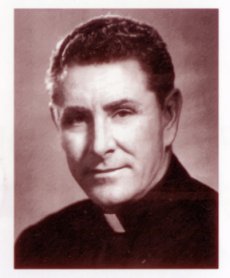
Fr Matthew O'Rourke SSJFr Matt had a vision of opening the deep South’s first mixed race Catholic High School, and so he attended night classes at the local New Orleans university for 5 years graduating with yet another degree; this time a Masters in Education. During this period, Matt became an active campaigner in the burgeoning civil rights movement of the time, trying to gain equality for black Americans. Traditional white supremacists sneered at the Catholic Church’s involvement, and several senior priests were arrested on trumped-up civil disturbance charges. Looking back, Fr Matt wrote:

“Discrimination because of race was almost total. Segregation was everywhere — in the schools, in public transportation, in the stores, in banks, in restaurants, at lunch counters, in the movie theaters, in the parks and swimming pools. Worst of all, there was de facto segregation in the southern churches.”

During these mature student days, Fr Matt eventually assumed full authority over the Raymond Parish of New Orleans. At the time of becoming PP, his city center Catholic Church was still holding one Sunday mass for the white congregation, and then a separate service for the black parishioners, mainly because the influential local white politicians demanded that segregation must be upheld in all public places. Fr Matt announced one week after taking control that there would be just one combined mass service under his ministry, in future. The New Orleans white so-called Christians were up in arms. Fr Matt told them to accept the way forward, or to go and find a different religion. The whites reluctantly accepted Fr Matt’s decision, and crowded into all the pews up front, with the blacks having to stand at the back. Fr Matt wasn’t finished. During his first combined mass sermon, he asked the black senior citizens to walk up the aisle, and he instructed the white families to shuffle around and find seats for their elderly fellow-parishioners. The “change” in local society had started.

In 1950, Fr Matt presided over the building of a new Josephite catholic parish high school. He was appointed the first-ever principal of St Augustine’s in 1951, and served in this role for a decade. Fr Matt invited the “excluded” local black children to attend his school, again to the alarm of much wealthier white families. Even the uneducated black kids were disinclined to join academic classes, so Matt recruited top sports coaches and encouraged the reluctant scholars to venture through the school gates and form initially all-black sports teams. A major turning point came when Matt arranged end-of-term challenge matches in football and basketball, whites v blacks. The whites scoffed but were forced to eat their words when the “Negro teams” trounced their new schoolmates at everything, including track and field events.

Soon after, Matt organized sports tournaments with neighboring schools. Most were unwilling to permit games with St Augustine’s mixed race athletes, but St Augustine’s teams invariably won the scaled-down competitions – and so each exclusive whites-only school lined up to attempt to beat the New Orleans champions from St Augustine’s; a mixed bunch of intelligent liberal white boys and promising muscular black athletes. Integration had been commenced forever, unwittingly in the eyes of white bigots. Of course, Fr Matt was soon able to tell his black sports stars that they had to join the academic classes if they wanted to remain on the sports teams.

Matthew’s foresight and determination was soon recognized by his superiors. He o+rourke+st+augustineeventually rose through the ranks of Josephite society, and became Director of Education during the turbulent 1960’s decade. Fr Matt now had the power and ability to mould the curriculums and entrance policies of every Christian school or college across America. Today, many black Louisiana politicians, business leaders and sports celebrities pay homage to Fr Matt (fondly nicknamed “The Chief”) and their all-round education at St Augustine’s during the 1950’s and in subsequent years. In truth, most African American students in the USA, past and present, should thank my Irish American first cousin for his relentless courage in gaining equal access to educational institutions for all races – something which is now taken for granted.

Photo (ReverendMatthewJosephORourke)Fr Matt visited his mother’s Irish hometown of Tubbercurry on several occasions, and composed his own hand-written version of a Family Tree after seeking out and interviewing relatives. About 10 years ago, I was privileged to be personally introduced to Fr Matt by a new-found NYC-based cousin, as Matt served in his last SSJ role as the Rector of St Joseph Manor in Baltimore, a retirement home for ailing priests from the 1990’s onward. He graciously sent me his detailed O’Rourke Family Tree, and I was therefore able to vastly expand my Neary Family Tree. I reciprocated his kindness by retrieving several Irish vital records featuring his father and uncles, and their forefathers, which Matt had never been able to locate. He said that I had made him a “very happy and contented old man” as he prepared to meet his Maker.

Shortly after his sister Margaret Mary died in Nov 2008, Matt took a heavy fall and broke his hip in seven places and fractured his femur. He was now aged 90 and even his nursing staff felt that the much-loved Fr Matthew would never recover from this devastating accident – but he did. Eventually confined to a wheelchair, Matt was able to communicate with me in Ireland via the phone and with his regular letters and blessings. Remarkably, Fr Matt had become fully computer-literate in old age, and he even sent me the odd e-mail as a disabled nonagenarian to advise me of the births of new family tree members across the world.

The renowned published author, civil rights pioneer and former School Principal and President, with the film star good looks, the Very Reverend Father Matthew Joseph O’Rourke, SSJ, passed away peacefully on 9th March 2012 at St Joseph Manor. He was buried on 14th November at the New Cathedral Cemetery in Baltimore.

2012 photo (Fr Matt)

Last photo: Fr Matt, The Chief (1918-2012) RIP

Ned’s Field

Apart from my grandfather Ned being (in)famous for funding Ireland’s longest ever pub crawl, I have only managed to pick up one or two other snippets of information about his life in south Sligo prior to his lifelong relocation to the windy moors of east Lancashire.

I am proud to say that one particular field in all of Sligo is still referred to as Ned’s Field. It’s a grand field, leading uphill to an ancient ring fort. It was sold to good neighbours called O’Hara in the 1930’s in order to finance the family’s “emigration” to the Promised Land of booming Lancs (just before WW2 broke out). I like to walk up Ned’s Field. It’s a pity that Ned’s cottage is no more – but Uncle John Neary’s place, right next-door still remains, and was occupied by John until very recently.

Tullinaglug #2

John’s cottage and his auld Raleigh bike

Prior to the departure of my Neary ancestors, a few memories remain, recalled by folk old enough to remember. For instance, old “uncle” John James Neary (2nd or 3rd cousin) born in 1924 laughs when he tells me how Ned saved on the regular cottage heating fuel of turf sods cut from the local bog (and dried and turned for weeks on end). Uncle John can recall going into Ned’s cottage and witnessing him burning a fallen tree trunk which was so lengthy that one end was on the fire whilst the slimmer end was poking out of the cottage door and into the “street” (as John describes a single track lane used by just two inter-related farming families). This tree trunk would burn away for a week or so, and would be shunted up to the fire by a few inches when necessary. Talk about domestic health & safety! These cottages had thatched roofs made of dried straw or rushes. Very flammable substances. A spark could have set the whole place alight – but it never seemed to happen. The Neary family would sleep through the night with their own form of central heating. The fires in south Sligo never went out, 24/7.

John also told me that “Kit” (Kate) Stenson, aka grandma [1852-1944], was always in her bed in the “top room” when he was brave enough to venture into Ned’s shack. The “top room” was the only separate bedroom in a traditional Irish cottage. The other 10 or 12 or 14 younger occupants (plus sow) lived in the same cramped space, maybe separated by thin cloth sheets hung from the rafters at bedtime. John told me that Kit was very kind to the young kids. She would put down her clay pipe and reach under her bedclothes and produce the equivalent of sweets or toffees for the modern child. John loved his childhood treats.

My dad’s best school friend pal in the 1930’s was Eddie or Ned Moran. This man is still living, but sadly he is now inflicted with total blindness. His memories are vivid. He tells me of rushing home from school with my dad (both bare-footed) with the intention of riding Ned Neary’s donkeys bareback, up on Ned’s Field. Worryingly he says that “Ned’s asses” were so thin that they would “split you in two”.

Ned Moran was also there when my Neary clan pulled out of the “street” and never returned. Apparently my dad shouted from the cart that he would see Eddie next summer. The two school friends never saw each other again. Unbeknownst to them, a simmering Neary feud about a trespassing sow or a wandering cock determined that Ned Neary’s family would never again set foot on their home sod [until I instigated a truce 70 years later]. Details to follow.

Eddie Moran said that he was brave as he waved my father off to England. He kept smiling and laughing, as instructed. His mother (Annie Gilmartin) had told him to be strong. Then Eddie brought a tear to my eye as he explained that he cried all the way home across the field, after Ned Neary’s ox-cart had departed for the railway station. His best mate, John Thomas Neary, never saw or contacted Eddie Moran again – but Eddie remembers him with fondness, and chuckles away at his memories of Ned’s Field, eighty years ago..

My Grandad’s (In)Famous!

When you research your family history, you secretly hope that you will uncover a tale or two which makes your ancestry unique, and possibly famous. You know, the type of story you can impress your friends with over dinner or whilst sharing a pint. By interviewing old folks who remembered my Irish grandfather’s existence in Sligo, before his permanent relocation to England, I was able to verify one such story. More than one person recalled the same tale – so this saga was “famous” considering that the events happened over 80 years ago!

At the time, my grandad Ned Neary was approaching 30 years of age, married with a clutch of young kids, with my dad being the eldest born in 1925. It was the day of the Old Fair Day in Tubbercurry renowned for fast and furious livestock sales, all conducted on the narrow streets and pavements of the town. Ned knew that the Old Fair would attract some cash-laden jobbers down from the North. These were cattle-dealers contracted to buy up the best stock in the Republic and cart them back to wealthy farmers in Ulster where beef prices were sky-high. As a result, Ned spent the eve of the Fair Day sprucing up his two finest calves. Their coats were washed and brushed until they were gleaming.

Early next morning, as planned, Ned’s best friend Tailor Currane from Gurtermone, ambled down the lane to the tiny Neary farmstead to assist with the transportation of the two prized calves. This involved attaching a leash to each young animal and then walking them all the way into town, ensuring that they remained in pristine condition. The plan went like clockwork, and Ned secured a prime bartering position at the bottom end of The (triangular) Square in Tubbercurry, just as the jobbers rolled into town. No-one quite knows what happened next, but clearly more than one jobber took an instant interest in Ned’s calves, and the outcome was a bidding war which resulted in Ned reputedly receiving a handshake of honourable spit – and the highest sum ever paid at the time for a pair of wee calves. Something in the region of £20 or more; a fortune circa 1930.

Well now, Tailor Currane was not stupid, although he was not a good tailor, and consequentially virtually penniless. He knew that his wages for the day would be paid in the form of a slap-up breakfast and a few drinks from the proceeds of the sale. He also knew that Ned was a fierce drinker, as witnessed when Ned’s notorious home-brewed Mad Man’s Soup was often devoured before it had cooled from the Still. So right enough, Ned and Tailor Currane went for a celebration drink right there in the town square. Flush with pound notes they had large measures – and to Hell with breakfast.

By late morning, Neary and Currane decided to embark on a pub crawl, to get farther away from the noisy farmers and jobbers who were now all arguing about the ridiculous price standard set by Ned’s early sale. All had to settle for less, except Neary and Currane who drank their way to the edge of town by mid-afternoon.

Their bahaviour was becoming more raucous, and not welcomed in the more respectable Tubber hotels, so Ned bought a drink for a farming friend from Curry on the agreement that he would ferry Ned & Tailor to their local hostelry at Kilcoyne’s in the back of the farmer’s ox cart. When passing Rhue, Ned decided that it was too early to be heading homeward, so he told his taxi driver to take the passengers all the way into Curry village. “We’ll have one or two in Cawley’s bar,” shouted Ned, to Currane’s delight.

Well, one or two became three or four more, and our intoxicated duo rambled from public house to coaching inn to hotel. When no longer tolerated in Curry, Ned and his buddy staggered down the main road south towards Charlestown. They’d worked up a big thirst by the time they reached the first bar in Bellaghy – so they had a drink. Onward they trekked. Ned was in Mayo by midnight, in the bright lights of Charlestown. He was now farther away from his wife and family than he had been at breakfast time, but he was in no fit state to go home. Anyway, Ned had hardly made a dent in the proceeds from his cattle sale – so he negotiated the purchase of a few after-hours drinks at Top Dollar provided that he and his comatose friend were granted lodgings for the night. The innkeeper obliged and showed Neary & Currane into a chic barn in the back-yard which had a welcoming hay-loft above. The intrepid duo drank themselves to sleep in the penthouse suite.

When morning came, it was time to attempt to eat something – for the first time in 36 hours. Currane was sent to contact Room Service. The innkeeper’s wife brought out a few boiled eggs and slices of warm soda bread. Soon, the boys were ready to hit the road. Now – Charlestown had many, many hostelries back in those days. Word had spread that Ned was in the locality, and each pub landlord made the Sligo lads more than welcome. “Try this new drink”; “Check out this whiskey from the north”; “Put a bit of soda with it”; “Down in one!”

A second day of celebration passed in no time at all. It was late into the evening before a fracas with some passing tinkers caused a few breakages of glassware and pub furniture. Another sympathetic (and opportunistic) landlady offered bruised Ned and battered Currane a lie-down on her bar-room benches. Another drink-filled day had passed.

The next day, Neary & Currane replenished their bloodstreams with plenty alcohol in Charlestown, but the drinking pace was slowing down. Ned was getting worried about the reception he would get at home from his dear but fearsome wife, Ellen. The local innkeepers read these signals the wrong way and ushered him and Currane out of their doors much faster than the day before. They thought that Ned was running out of money and would soon be seeking credit. This was far from the truth. He still had a pocketful of pound notes. Or maybe it was the smell of Currane’s body odour that made yesterday’s friends turn up their noses.

The poor tailor had a temporary solution to Ned’s woes. “Let’s walk south down to Ballyglass. We’ll get a good welcome at Billy Gallagher’s place. I made him a suit for his wedding.”

“Yes. I remember,” agrees Ned. “A bad suit.”

They got a great welcome at Billy’s bar, with Billy grateful for any midweek passing trade. Similar receptions were experienced at Tommy Murphy’s and Dicky Flynn’s (et al), and in another day or two the Sligo lads had bypassed Knock Shrine, and all its guilt-ridden reminders that Mass had been missed, and they were on the road to Ballyhaunis. In this town, Ned had to admit that funds were getting low. The poor tailor Currane could not contribute a penny, so he reluctantly agreed that a pub crawl homeward was on the cards.

The route home passed back through Charlestown, on the townsfolk’s very own market day. The pub’s were jumping. It would have been ignorant not to thank each innkeeper for their earlier hospitality. And so it passed that Ned Neary spent every last shilling on whiskey and beer … and then trooped home in his worn-out old boots.

Many in the area can still recall or have heard about this world-record pub crawl. Differing reports talk of Ned being away for “over a week”. By my calculations based on the buying power of £20 at 1930’s shop prices, it is more likely that Ned had enough cash to endure a fortnight’s drink-fest for two. It’s a funny story, and on another level, a rather sad story. Just imagine how it felt for Ned’s wife (my grandmother) as she tried to feed herself and her babies – and maintain the farm – with the man of the house away on an unannounced rambling holiday. Somehow, Ned & Ellen remained together for the rest of their long lives, and made more babies. That’s how it was back then. No divorce or separation.

The infamous saga of Ned Neary’s pub crawl is recounted to me every time I bump into Hughie O’Gara, a man who was a neighbour of Tailor Currane. This usually occurs in the Roaring Cock, with Hughie shouting his recollections across the bar in his booming Dalek-like voice for all to hear. As such, the story can never be forgotten locally. Hughie chuckles with laughter, his shoulders bouncing up and down, thinking that he is embarrassing me.

On the contrary, I have turned the tables and I demand that when Hughie next sells two calves for a decent price, then me and he will re-enact the Neary Ramble, although I insist on crashing out at decent 3-star hotels. It’s about time a Gurtermone man paid back his dues to the generous Neary clan, after Currane’s mighty free-loading escapade. I have also told Hughie that I have applied to Mayo Council to get a commemorative Blue Plaque erected in Charlestown, by the horse trough used by Ned for his ablutions, to remember Ned’s distinguished contribution to the Licensed Trade.

As a consequence of all this, Hughie’s weekly chuckle-some greeting to me, in that Dalek voice of his, is always the same:

Are we going to Char-les-town today?

“What Hughie?”

Char-les-town! CHAR-LES-TOWN!

Okay, Hughie

Okay, Hughie

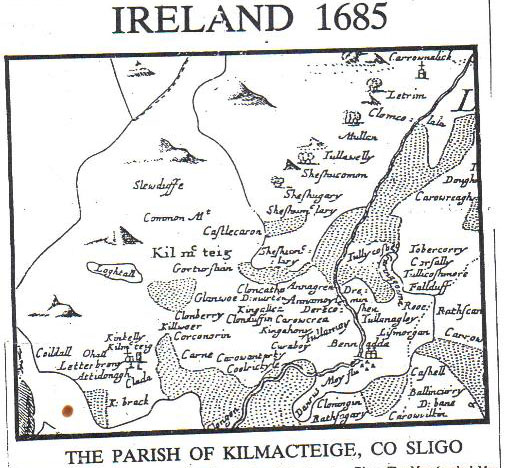
Clada Asses in the 1600’s

Down Survey Map

                     Down Survey Map

We don’t mind if we couldn’t spell, or use proper grammar. We could talk. We did talk (in our own language).

And we told tales, and if the townsfolk didn’t like it, so what? We looked after our own; yes, our own asses. I am proud to be a Claddagh Ass. We survived, and we watched them come and go. Where are they now – those that mocked? In the New York smog, or Boston slums; or drinking dewdrops from the mountain, and eating salmon from the Fiddann? We wish them well. They probably wish they never kicked a Claddagh ass.

Older than ye think, are we

Old Clada asses are older than ye think

Déantús an Phoitín

Poítín Recipe

Ingredients:

  •  Granulated Sugar – several stones
  • Yeast – a few pounds of the stuff
  • Spring Water – gallons and gallons
  • For a pleasant change, try an alternative malt and barley mixture, plus yeast, in the same secret quantities.

Get an old barrel and make sure that it is washed out properly. Then melt the sugar but don’t let it burn. The sugar semi-liquifies as it begins to melt. Place the yeast in another container or bowl and break it up with your hands.

Heat the barrel with a drop of hot water. When heated, put a fistful of yeast into the barrel and then pour in some lukewarm water on top of it. Add a good dollop of melted sugar. Throw a wet cloth on top of the barrel and let the sugar and yeast dissolve into the water. The cloth helps to keep the smell down, which is very important.

Place the barrel in a secret dry place. Put hay all around it, including under it, and over the top. Leave it like this for three days. When you go back to the secret place after three days, repeat the same procedure over again, in the same way you did it before, with the yeast, sugar and lukewarm water. Keep doing this over and over, over several weeks, until the barrel is almost full. You now have a wash.

Poitin making sketchWhen the mixture is ready, thin it out with water, preferably potato water. For added flavour, put a bit of treacle through it. This crucial preparation stage is now complete, and the mixture is ready to run.

To run it you will need a steel drum with a lid, copper piping plus a basin with a hole in it. The hole must be the exact same diameter as the copper pipe – because the end of the pipe is pushed neatly through the hole. A worm is also needed and placed into the drum. Always ensure that your drum and worm are thoroughly clean.

Heat the drum gently on a turf fire, and watch as the steam turns magically into whiskey, in the form of a totally clear water-like liquid. Continue running your mixture very gently. When the running is near to completion, gather your whiskey from the still and worm, and then put it back into the top drum one more time and run it again.

When cooled, drink in moderation with your appreciative neighbours – but only after treating the fairies. It would be a pity to be cursed for the rest of your life, after all that patience and endeavour.

If you opt for the malt and barely alternative, there is a lot more hard work involved. Say, you had four stones of malt and barley, then you would have to leave it in water for about three weeks until buds appear. Next, you throw the mixture out onto a dry loft and you have to keep tossing it every day. Do this until the bud goes back into the seed. Finally, you crush the seeds and then put them into the wash barrel with some yeast and lukewarm spring water. The extended process is worthwhile. You will be rewarded with a spirit which your neighbours will declare is ‘The Best of Whiskey’.

Quality Control 

To test the success of your distilling skills, light a small piece of paper and put it into a small sample glass of the liquid (whiskey). When it stops burning, the remaining liquid should only be pure water. If there is a good flame burning from the liquid, that suggests that it is a good whiskey, and can be classed as Mountain Dew. Also check that a nob of butter sinks in your filled whiskey glass. If the butter floats on top, then you still have too much water content and you should return to the still and run away.

A surefire way of testing the alcohol strength of your brew is to boil the whiskey and then let it cool off. When the bead on top is not too strong, run it another time and throw some salt into it. If big bubbles appear at the top of the whiskey, it is strong stuff. This spirit is categorized as Mad Man’s Soup; true poítín.

Always, ALWAYS, throw the first drop of poítín to the fairies. Otherwise, supernatural beings will haunt your furtive drinking session. In modern parlance, this is called “hallucination”.

Various Uses for Poítín: 

Never let poítín into the wrong hands. Share discreetly at local weddings or for a wake house or with someone who is sick – but never let it into the wrong hands. Your livestock will appreciate a drop as well. To liven up your cattle, mix it with milk and let them slurp away. Poítín is particularly beneficial for people with Arthritis or Sciatica or pains in their knees. For additional pain relief, use internally and externally. Rub the poítín into the affected area. The first run of whiskey is considered the best for aches and pains, or maybe you just don’t feel anything when you sample the second or third runs.

Transportation: 

Distribution of your excess whiskey for commercial gain is fraught with danger. When caught on the road, Master Distillers of old were rarely transported overseas, but the County Court Judge will impose hefty financial penalties in the knowledge that your neighbours and customers will stump up a few quid in order to ensure that the still is removed to an even more secret place. Use vigilance and cunning. Here’s an example from our parish:

In the troubled times of 1921, an old woman used to bring Póítín into Tubbercurry and sell it to the big shots in town. She was a mighty woman. The ruthless Black ‘n’ Tans were around at that time; and they used to hold people up on the road, checking their carts. Our heroic old lady used to transport the poítín in kettles. She would fill the top of the spout and seal the lids on each kettle with buttermilk. The soldiers would ask her what was in these kettles and she would reply, “Can you not see that it is buttermilk which I sell to the poor people at the Tubbercurry market each week.” She was known to have one of the most popular stalls on the market, so the local army sergeant was suspicious.

One time, the soldiers followed her out of her village, on her way to Tubbercurry, intending to conduct a thorough search of her cart, away from the busy main road where rebel youths stoned the Brits if they hassled the old locals too much. Word of the soldiers’ presence in the parish was quickly passed to the farmers up the lanes, and a baying mob attempted to delay the platoon as it marched behind the old lady’s cart, passing through Banada. The commotion allowed just enough time for our heroine to lead her ass to the River Moy bank for a drink, out of sight, below the bridge.

Quick as a flash, she tied together the kettles containing whiskey with a string, and dropped them down into the river below the reed beds. She always had them well-sealed, so the Mountain Dew was safe. When the soldiers eventually caught up with her on the riverbank, the sergeant hinted that he would instruct the Moy to be dredged. Not to be outdone, the brave old lady grabbed her carbolic from the cart and immediately started to strip off her clothes. “Will you give me the courtesy of bathing in private – or do the British men have no scruples at all?” howled the old woman. With her underwear now in full view, the soldiers did not know how to react, but the cursing farmers made a decision for them with their shouts from Banada Bridge. “Let a lady wash in peace! Get back into town or we’ll send word to get your barracks burned down!” The red-faced soldiers beat a hasty retreat just as our dear old poítín pedlar plunged fully naked into the icy waters. She was a hardy woman, LORD HAVE MERCY ON HER, and she was never stopped on the road again.

Hiding places: 

Bogs, drains, hen houses, haystacks and manure heaps are recommended common places to hide poítín. However, having uploaded this info into the public domain, you had better not hide your poítín in bogs, drains, hen houses, haystacks or manure heaps.

Poítín & The Fairies:

If you drink poítín in the company of more than one person, then you must always pour out an extra measure for the fairies. One measure is sufficient because they are very small in stature compared to the human frame. Leave this tot outside of your drinking den, in the open-air. It will always be gone by the time you wake from your poítín-induced coma.

Scientists have discovered that virtually pure alcohol rapidly evaporates when left in an outdoor atmosphere – but what do they know? It’s better to be innocent and safe, than sorry.

This stuff is no good - it's legal

          This stuff is no good – it’s legal

The Fair Day in Aclare


(Recounted by John Sheerin, 25th February 2001)
 

“On the fair day each townland had its own area where they kept the cattle.  The people from Gurterslin and Drumartin areas always parked near the entrance of the village on the low road. The people from Tourlestrane, Carrane, Tubberoddy and Coolreagh parked from the barracks up the high road.  Carrowloban, Kincullew and that area parked down the main street. The Killassers parked on the bridge.  Each townland had their own place to park.  When the cattle were sold they were put into Leheny’s yard. Then they were loaded on to lorries up the road.  Before my time, the pigs were taken to Sligo. The farmer of that time would bring the pigs by horse and cart to Sligo. They would bring loads of meal and flour back on the return journey. 

There were a lot of pubs in Aclare in those days. Some shops had both groceries and hardware on sale. There was Kathleen Feehely, Loftus’s, Higgins’, Ellen Haran’s (which became Mayes), Bradleys, Flatleys and Quinns. We had the fair winter and summer.  Each farmer herded his animals in a cluster. The villagers from each townland would hold their animals together up against a wall or steer them around the street. Everyone watched their own cattle. 

The sheep were on the backway. They were held with the dogs. They stayed together. When they had walked ten miles they were damn glad to stand for a while. When they were bought they were taken home on carts. 

Aclare market, Co. Sligo

                                     1961 Aclare Fair Day

The country people brought the banabhs in on carts.  They’d sell them in front of Gallaghers. Touhy’s from Ballaghaderreen came with lorries for banabhs, which they kept in crates. 

On the fair day the village was hard to pass through. It was noisy with voices bargaining, donkeys braying, the mooing of cows and baaing of sheep. The smells were strong. The place used to be in an awful mess when the day was over and the animals were taken home. The next day the County Council would come and sweep the streets. There was no water or electricity that time. We didn’t get the electricity until the 50’s. In the late 50’s we got the water on tap. 

Of course there was many a row on a fair day. When the tinkers were around we often had fights with them. Mind you, not on fair days. One day there were only two guards in the barracks and a row got up. The guards came looking for help to put the troublemakers out of the village. Four or five of us tackled them with the guards. We put them out over the bridge and gave them a good hoisting. Nobody got injured and there were no bad feelings. The fair days were great.  I miss them.  They ended sometime in the 60’s.  Then the mart was started in Aclare by Kennedys.  That continued for about ten years. 

The village had a shoe maker called Dinny Walsh. Kate Fahy was another shopowner. She sold sweets. Other owners were Bretts, Sheerins, McAllisters and Evans. Each shop had a hardware section. Charlie Brett was the blacksmith. Years before I remember there were three bakeries in Aclare; Loftus’, Higgins’ and Lundys. There was also a cooper who lived down at the edge of the river where the car park is now. I don’t remember him but he was in it. There was also a butter house down along the river.  

But getting back to the fair day. It was one of the best fairs in Ireland. The jobbers used to come from Sligo, Ballina, Northern Ireland and Roscommon. The fair was held on the last Wednesday of the month. We stayed in the shops and protected the outside by putting barrels and bars on the streets. These stopped the cattle coming up on the footpath and breaking the windows. 

The jobber would come along and ask the farmer the price of the animal. They made the bargain and finished the thing with a slap of the hand. The deal was made. After that they’d go into the pub and have a drink.”

Manners and Customs in Old Kilmactigue

The reverend James Neligan (1752-1833), who was the Rector of Kilmactigue from 1802 until his death, has left us a most interesting insight into the lifestyle of this once densely populated Parish in the south-west of County Sligo. In his dual role as vicar and magistrate, he was well-placed not only to observe but also to comment on the manners and customs of his fellow parishioners, the majority of whom were Roman Catholics. His relationship with his co-religious was such that on occasion he rented the local chapel for the use of his small flock.  In his obituary in ‘Saunders News Letter’ he is referred to as a “scholar, poet and gentleman”.

 “ The parish of Kilmactigue, which has a rectory and vicarage, is situated in the barony of Liney, county of Sligo, and diocese of Achonry.  It is six miles in length by four in breadth; bounded on the east and south by the parish of Achonry; on the north and west by those of Killasser and Attymass.  A long range of mountains passes through it, most of which is pasturable; it also contains large tracts of wet bog. No woods are to be met within the parish; although in former ages a great part of it must have been covered with timber.

The number of families – by a return made last year by the priest – amounts to twelve hundred Roman Catholic families, to which may be added to the ten Protestant families, four of which have come lately to the parish. The number of houses is stated to be eleven hundred and fifty, to which are to be added those of the Protestant part of the population; in many of these there are two families living together.  Many of these families keep a servant boy or girl, and sometimes both, for three, six or nine months in the year, to assist them in their work.  It is computed that there are on average five children in each family, or rather a house, which however must be a rather large a computation, as many are old people, and many newly married.  The proportion of males and females is nearly equal.  They are mostly poor, maintaining themselves on small portions of land, for which they generally pay a very high price.  There are not thirty families in the parish who pay any of the public taxes included under the hearth and window duty, they are notwithstanding, tolerably healthy, though confined to poor diet, such as potatoes, with milk and eggs occasionally. The population, as well as the prices of provisions, must  have increased very much within the last forty years, as that time Archdeacon Hutchinson,  who was the incumbent, could set the thythes (both rectorial and vicorial) for only £85 per annum, which now exceed £400.

Early marriages is perhaps the principle cause of the great increase in the population.  The young women are generally married from the age of fifteen to twenty, and the men from twenty and upwards.  The portion usually given, is from ten pounds to fifty with the girls, and the young man has generally a smallholding of land, with perhaps a few cattle, to begin the world with. A few instances may occur where one hundred pounds may have been given as a portion with a bride, but such may indeed be called a ‘rava avis’. These marriages are contracted in most instances, without any regard to love, affection, or any of the finer feelings, and are concluded between the friends of the young people, without any reference to their choice or judgement; and it frequently happens, that the bride is dragged to the hymeneal altar, bathed in tears, and compelled to take a companion for life, who is chosen by her parents from prudential motives.  The chief time for marriages is from Christmas until Lent, being the season of the year when people have the most leisure for settling such business.

 When the parents of a young man think it is time for him to take a wife, they consider what young woman in the neighbourhood will be likely to answer the purpose, and having determined on one, the party goes to make the match, as they term it, which is done by sitting up the whole night, talking over the terms, drinking whiskey and smoking tobacco.  The match being concluded, the day is appointed for the marriage, at which time the parties assemble at the abode of the woman, where the priest attends and a plentiful dinner or supper is prepared for the occasion, at which a large number of the friends are entertained, and the abundance of whiskey distributed amongst them; perhaps ten gallons, or more, the price of a middling cow; this, with the accompaniment of a piper, enables them to pass the night in the utmost of festivity. Dancing makes a considerable part of the entertainment, and is considered as a necessary accompaniment amongst them; and hundreds who have never learned the alphabet, or spoken a word of English, have regularly attended the dancing schools, and, at no small expense, become adept in that science.  Singing the old Irish songs makes also a principal part of their entertainment, which they execute with great correctness, as many of them have sweet and melodious voices, well adapted to these melancholy and plaintive strains. Things go on very well in the beginning of the night.

 As long as the reverend pastor holds the chair, he keeps them to regularity and good order; but afterwards the scene changes, and exhibits chaos of tumult, vociferation and drunkenness.  Perhaps three musicians may be  found playing to as many as sets of dancers, a dozen men and women singing as many different songs, and other groups employed in altercation and quarreling. Thus two or three days and nights are spent, before the parties disperse’ and it frequently happens that there is as much money lavished on the entertainment as would amount to half the fortune of the bride.  Such however is the custom of the country, and such the pride and spirit of the people, that they would lay out their last shilling to furnish the feast rather that be thought singular or churlish.

It is only on such occasions as weddings and christenings and at Easter and Christmas, that they afford themselves any sort of animal food. Potatoes furnish the standing dish three times a day throughout the year, except that in summer, when they begin to grow scarce, those who can save a part of their oats from the landlord’s rent, make little meal, which they use either for bread or to make gruel, which they make with their potatoes.

 Although almost every family has one cow, and many of them more than one, yet their pasture is so bad, and their winter feeding so scarce and indifferent, that they have very little milk at any time; but for the winter and spring months scarcely any, particularly if their cows are in calf.  Those who have even one cow put by all the sweet milk for the churning, and use none but the buttermilk; by so doing, they make half a hundred weight of butter in the season, and perhaps more, which they will sell at Sligo, where it is brings from £5 10s to £6 10s. per cwt. and which enables them to pay their rent. They have a good many fowl, and plenty of eggs, which the women sell to procure the price of tobacco, (a luxury to which they are immoderately attached), and such is their infatuation, that, notwithstanding their poverty and nakedness, each family will expend from 10d to 1s 8d per week on that abominable weed, where it is used by the man and wife; for although they could buy as many salt herrings for that money, as would afford them nearly every dinner every day along with their potatoes, they prefer eating them dry, to the want of their beloved tobacco.

The understanding of the inhabitants of this parish, though uncultivated, is acute; they are generally hospitable, complaisant and honest.  The Irish language is universally spoken, but few of them can speak English.

A great number of Saint’s days are observed, which, however, are spent in idleness and drinking, to the great injury of the people, both as morals and industry.

The Lady Days are observed with the most scrupulous attention, that is to say, so far as abstaining from all kind of daily labour, or following trade or calling, although their sanctity does not operate on their minds so as to induce them to refrain from sports and pastimes, cursing or swearing, or frequenting tippling houses, and drinking to excess. At the same time it is not unusual to see then actively employed on Sundays at their usual labour, without seeming to think that they are transgressing a positive command of God, or doing an act either sinful or indecent.  With an equal strictness they observe the fast from flesh meat on Fridays, and during Lent; although if an opportunity offers, they would not scruple to get drunk at these times. On making enquiry from some of the more decent of them, why they acted thus and why they transgressed the positive commands of God, with so little feeling, while they obeyed the ordinances of mere men with such exact devotion, the writer was informed, that their church, which taught them to do so, was infallible, and that it was their duty to obey its decrees.

To the fondness they have for observing holidays, may be added another propensity highly injurious, that of attending at the fairs and markets in their neighborhood, although they have no business to transact there.  From these they seldom return without laying out some part of their small means for whiskey, which often produces rioting and fighting; this is followed by a further loss of time, and waste of money, in going to the Magistrates to obtain justice, and from thence to the Sessions to prosecute their suits. Often indeed they settle their disputes at home, by reference or by arbitration, and the same ingredient which originally produced the quarrel, and marked their heads with bleeding scars, becomes the means of adjusting the dispute; for the compromise is never entered upon but where whiskey can be procured, and here the parties are well fined, by paying for the liquor employed in treating the Brehons, (for thus the arbitrators are called in Irish) and the friends and witnesses who attend at the reference. 

Another source of idleness amongst them, is the constant attendance given at the wakes and funerals of their neighbours; the neglect of which would be considered as a crime of the blacked dye, and an offence not to be forgiven.

It is also a custom amongst them, that when any person dies in a village, all work and labour is totally suspended by all those living in the village, or within a short distance of it, until after the interment; the intermediate space is usually employed in visiting the house where the corpse is exposed, smoking tobacco, or entertaining themselves with certain plays or tricks, which are practiced by the young folks, (some of which are particularly expert in performing these) and which enable them to pass away the long night in the greatest mirth and hilarity; so that a person unacquainted with their customs, passing by, or visiting the house, would be led to believe that they were assembled for the purpose of celebrating a marriage, or commemorating some joyful event rather than condoling with the disconsolate friends of the deceased.  Among the more wealthy people, victuals are provided for those who come to the wake from a distance, and also a due proportion of whiskey and abundance of tobacco and pipes; some of which is also brought to the burying place, with which they regale themselves while the ceremony is being preformed.

These several expenses, which are deemed to be indispensable, and highly creditable to the deceased and to their friends, together with the fees to be paid to the priest, amounting to eight shillings for each person, and the Masses read for the soul of the departed, to bring him out of purgatory, amount to a considerable sum.  The burial of a wife with all the necessary appendages, may in many cases, amount to half the portion which the husband, wife, or child is spoken of, the complaint does not seem to turn so much on the loss of the person, as on the money it has cost the money for the interment.

Among the genteel and opulent families, besides the usual Masses celebrated for the souls of the departed, there is another, no less strange, but to which an uncommon degree of merit and virtue is ascribed; this they call ‘A Month’s Mind’.  The ceremony is attended by as much of their clergy as they can procure at the house where the person dies; where the forenoon of a certain number of days is dedicated to Masses and prayers, for the liberation of the soul of the deceased from its intermediate prison and to send it to the abodes of the blessed; whilst the afternoons are spent in conviviality and innocent recreation, for the purpose the best meats and drink which the country can afford are procured.

The surest proof of the goodness of a man’s life seems to be the largeness of his funeral; and therefore great care is taken to have the remains numerously attended; so that the hundreds, and sometimes thousands are seen assembled to commit one poor putrifying body to its kindred earth, whilst the air resounds with the melodious voices of a large assemblage of females, notwithstanding the doleful and melancholy cries uttered by them, are totally unconcerned about the deceased, and never sully their cheeks with a falling tear, to denote their grief.  A priest was stationed here lately, who, if he had continued, seemed likely to remove some of their gross prejudices, and some unreasonable practices.  He began by prohibiting the use of this Irish Cry at funerals, as being in itself useless, and only fit for uncivilised society.  Reason and good sense, aided by the authority which the Catholic clergy possess over the minds of the people, produced the desired effect, and put a stop to that practice so long as he continued on the parish; but on his removal, they fell into their old practice as fully as ever, so difficult is it to eradicate prejudice confirmed by long custom.

Extract from ‘Parish of Kilmactigue’  by Revd. James Neligan,, rector and vicar- as published in Mason’s ‘Parochial survey of Ireland’, Dublin, 1816

 Blimey – nothing’s changed.


Story-Telling

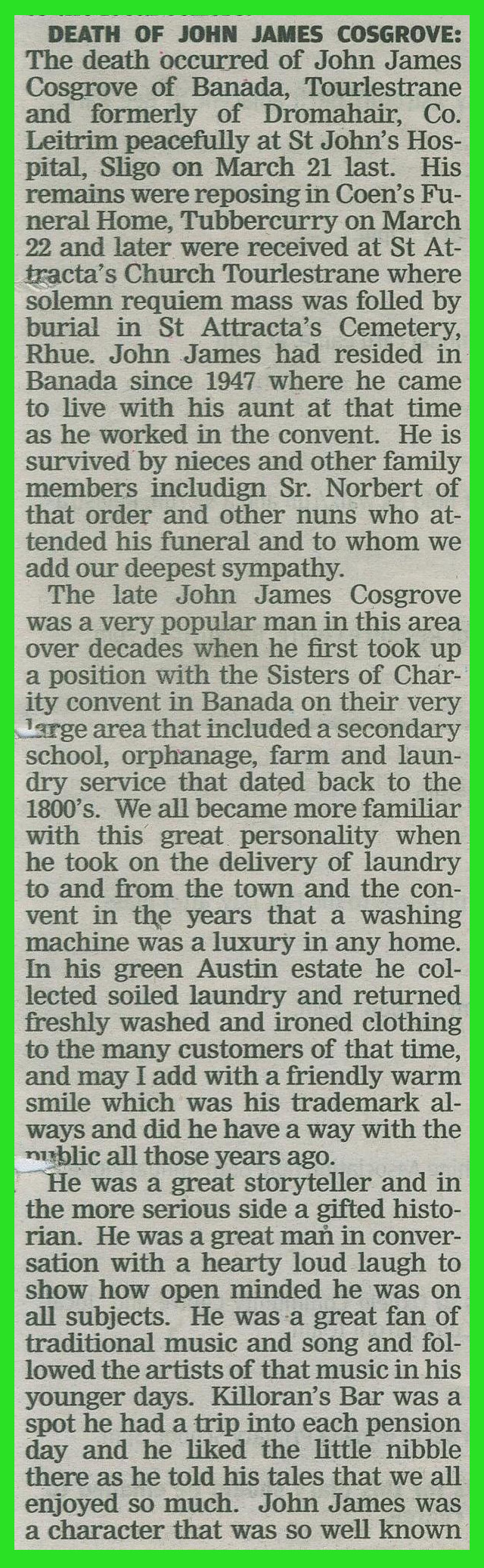
John James Cosgrove died last night, 20th March 2013. He was born in Leitrim in 1927, VLUU L310W L313 M310W / Samsung L310W L313 M310Wand relocated to the south of County Sligo aged 20 in 1947. After a difficult start in life, he devoted his remaining days to helping the Sisters of Charity raise and teach unwanted children and orphans at Banada Convent. In return, they helped him to find a home and an identity in County Sligo. John James never married, but he loved traditional Irish music, a game of 25’s, and the craic. He also preserved the ancient Irish art of brewing a “fine drop” with the blessing of the fairies.

A while back, a local radio station visited his “local” to record the music and story-telling. John James was full of amusing stories from the auld days and he was asked to give a recitation to the listening audience. After a couple of refusals, and a couple of brandies, this is what he got up and recited to an enthralled audience:

It was a few days before the All-Ireland Football Final, way back in the 40’s and 50’s, when this lad from Tubbercurry decided he’d like to see the big game. All the trains and buses to Dublin were fully booked for a week in advance, so Paddy made a plan to cycle all the way to Croke Park. He set out in good time on the Thursday. He had a mate in Longford who put him up for the first night in a pub just outside the town. Then on the Friday he cycled all the way to Maynooth where he had a cousin in the seminary, training to be a priest. Paddy said a few prayers in the Maynooth chapel on Saturday, and then headed off to the big city for the big match the following day. He got digs with a nice family near the stadium, and he was all set for the Football Final after mass on Sunday.

Paddy had about four hours until the throw-in, so he ventured into a few pubs. The Sligo and Leitrim buses were pulling into town and the fun to be had was mighty. If all truth be told, he had a few too many pints of porter. Anyway, the pubs started to empty as the teams began to line out, and the lad from Tubber was carried along by the crowd heading for Hill 16. The game passed in a blur. It was a close game and it didn’t matter who won or lost. It was a thrill to be there, simple as that.

After Sam was awarded, all Paddy’s new friends headed back to the north Dublin pubs outside Croke Park. The lad from Tubber thought “I’ll just have a roam, and then find some more digs on the way home.” Well, he had one for the road, and then one or two more – and then he couldn’t remember where he’d left his trusty bike at a quarter to four. He was sure he last saw his bicycle outside a pub near Parnell Square, so he had a few more jars up the top end of O’Connell Street but the bike was not there.

As midnight approached, he searched the back alleys. Apart from courting couples trying to hide, the Sligo lad could find nothing to ride. Before he knew it, he was down by O’Connell Bridge. It was late, and cold, and he was hungry, and exhausted from his day out in the capital city. He saw a few vagrants laying out beds on the bridge’s wide parapets; they looked lost but okay. He grabbed some cardboard boxes, and down beside the tramps he lay.

Paddy must have dozed off because the next thing he knew, a big chauffeur-driven car pulled up by his pew. The rear door opened and a pretty blonde lady said, “Why are you sleeping here, when I have a bed?” Well the lad from Tubber woke with a start, and he climbed into the back of the wealthy lady’s cart.

As they drove through South Dublin, our laddo told his tale. The kindly lady said, “I’ve no bike, but I’ve got hot food and ale.” The chauffeur dropped them outside a big house, and he was welcomed inside. The blonde lady prepared him a hot bath, and a clean robe she did provide. She told him that she’d cook him a steak dinner to be washed down with cold beer. Paddy was in heaven, thinking “I’ve hit the jackpot here.“

After dinner, they danced and started to kiss. I’m nearly at the end now, if you’re needing to p …. pay a visit.

“Now Paddy,“ says she. “Go warm my bed up, whilst I powder my nose“. Without no more prompting, young Paddy lay his head on her pillows.

And then she appeared in a see-through negligee, and the boy from Tubber thought this really is my lucky day. “Move over” she said, as she climbed in the bed, giving our Paddy a peck on his forehead.

“Move over a bit more.“ The room span and he went all dizzy in a jiffy. And that’s when our Paddy … fell into the River Liffey.

County Sligo have never appeared in a Men’s All-Ireland Football Final in Dublin. Neither have John James’ native county of Leitrim. That’s what makes John James’ story-telling all the more ridiculous and charming.

Obituary

Obituary

There’s two “L’s” in Tullinaglug

Hughie insisted that there was “two L’s in Tullinaglug.”

Morris retorted that he should look at the old maps. “There’s definitely three L’s in Tullinaglug.”

“Bollix!” shouted Hughie. “There’s Molly Moran’s well, and there’s Neary’s well. Behind the cottage, by the cow shed.”

There’s no answer to that. It’s true.

John's cottage and his auld Raleigh bike

The well’s round the back

Census of 1659

There are returns available for 26 counties, and some of these returns are incomplete.  It is thought that these figures were compiled by surveyors working for Sir William Petty, Surveyor-General of Ireland, who mapped confiscated lands from 1655 to 1659. The returns indicate the number of people living in each townland, and whether they were native Irish or of English origin. 

Figures for the parish of Kilmacteigue:

Irish                            English                        Total

224                                 6                                  230

1659 chart

Where’s Merrill? …. where’s the novel

The e-book version of Where’s Merrill? [A Genealogical Thriller] was published on 28th February 2013 and subsequently released in paperback during 2014. It is available to purchase for just a few dollars from:

© AMAZON or

© LULU or

© SMASHWORDS

WM manuscript cover blog #1 copy

          #1 AMAZON Best-Seller 2014

Go on …. read it and try to help solve some lingering mysteries

Black Sheep

Former parish Priest’s Death:

The death took place after a long illness at Árd na Gréine Nursing Home, Enniscrone, of Conor Liam Cawley, retired parish priest of Charlestown. His remains were removed to St James’s Church, Charlestown, and his burial mass took place in church grounds. He is survived by his brothers xxxxxx and xxxxx, his sister xxxxxx, brother-in-law xxxxx and sisters-in-law xxxxxx and xxx, nephews, nieces and friends. The late Conor Cawley was parish priest in Charlestown for a number of years until his illness and retirement. He did much good work in the parish and was hugely involved in the big renovation work of St James’s Church. Sincere sympathies are tendered to the bereaved.

This “man” was a relative of mine. You cannot choose your relatives or ancestors. This bland obituary hides the criminal allegations laid against Fr Cawley long before his death. In Ireland of old, The State and Judiciary were loathe to prosecute the fine, upstanding men who served as Roman Catholic ministers especially if they were “sick”. In the locality, Father Cawley was renowned for his indiscretions, of a sexual nature. Employed as a schoolteacher, alarm bells should have rang out loudly. Nothing was said. As a consequence, Fr Cawley was promoted to Canon, so he continued to enjoy swimming with the nuns and the orphan girls.

Whilst my distant cousin rotted away in Enniscrone, attended to by dedicated nursing staff, one of his victims of childhood abuse could no longer live with the scars of being disbelieved. She committed suicide. Again – nothing was said.

No prosecution was ever forthcoming from the Garda Síochána; the guardians of the proud Irish Republic.

All-Ireland Inquest

Dear Danny,

Went to the Roaring Cock yesterday lunchtime for a pint and the post-All-Ireland inquest discussions. I overheard this bar-room conversation between two locals:
“What time did you leave on Sunday?”
“I dunno. I woke up in Charlestown, early hours Monday. Why – what time did you leave?”
“I dunno.”
“So – did I see you on Sunday?”
“I think so.”
The Irish really know how to celebrate big sporting events.

Gearoid, Ha ha, brilliant ! I was really sad to hear The Green and Red had been beaten again; I thought they might have done it this time around. I’m sure mighty craic was had whatever. Did you watch it in the Cock ? I was wondering if the Killybacside gang were for Mayo or Donegal.

Danny, as you should know – Mayo & Sligo are in the Connacht province, and even though Mayo “bet” Sligo in the Connacht final, healthy local tradition says that you support your neighbours – even after defeat. I know it’s the opposite in Lancashire. Could you ever support Burnley in the FA Cup Final if they beat Blackburn Rovers in the semi!! Then again, this FA cup final could only ever be played on Fantasy Island.

Donegal play in the Ulster Championship. They are close neighbours but they’re separated by a small strip of Leitrim. We were glad that the GAA final involved two teams from the West for a change, but the Green & Red flags were flying in our parish on Sunday. My great-grandmother was a Mayo lady, so I cheered them on too. I was first in the Roaring Cock on Sunday morning (before the bar officially opened), escaping early from yet another midday funeral mass. I even beat old Hughie O’Gara to the bar, and he is a permanent fixture on the bar stool by the turf fire. I took my car home when I was only 1 or 2 jars over the limit, and vowed to return if Mayo got off to a good start. They didn’t. Two goals down in no time. Game over – barring a miracle. So I got sozzled at home, channel-hopping between Premier League soccer, GAA & Formula One.

I think Mayo’s failure just contributed to excess partying in the Cock for no good reason at all. Many say they cannot remember the second half – or the next few hours – or the closed door session after midnight, etc. Where do they get the stamina? Years of practice, I suppose.

Gearoid, I am so happy. I slept ! I went out for dinner with the Dublin/Nottingham girls and had a few beers before I leave Pamplona; I put the earplugs in to drown out the phantom snorer and was dead to the world. Today’s another day. I woke at 6.00am today pleasantly surprised to have slept so well. I wasn’t at all surprised to hear that ”Foghorn Leghorn” had kept half the dorm awake again. In the spirit of the Camino, I gave a spare pair of earplugs to an Australian pilgrim who looked like she was more in need than I was.

Early start for me too, today, Danny. Got to research some Dubliners called Costello, a typically Irish surname – but they turn out to have been the Costa family originally from Lucca in Tuscany 200 years ago, and then they started to appreciate their Italian heritage in the 20th century and they start calling themselves Castello after further emigration around the world. Irish genealogy is never straightforward, especially as many Irish folk “adopt” forenames in adulthood which were never mentioned on their baptism records. I have Irish three aunts; my dad’s sisters. They were always known to me in Lancashire as Maureen, Eileen & Doreen. It turns out that they were born as Mary, Attracta & Joan ….. and even Hughie O’Gara (Cock fixture & fitting) was never christened as Hugh or anything like!

Danny, as you’ll appreciate, drink-driving around our parish involves keeping your vehicle in the two well-worn ruts in the single track lanes separated by the green strip of overgrown grass which has sprung up from the ancient tarmac last laid decades ago. It is impossible to leave the road, but meeting a fellow drink-driver coming the other way is a difficult challenge. And if the approaching fellow traveler is perched upon a rusty old red (unlicensed) tractor, then take evasive action. My shiny new motor now has the scars of one of these encounters.

But a bump or two on the family car is like a badge of honour around here – as is the 12 months driving ban for those heroes daft enough to venture into town after a few pints in the village “shops”. Liver complaints are unheard of – but bowel cancer seems to be the price you pay in old age for a lifetime of living off nothing more than Guinness soup. The recommended local medicine for bowel cancer is more Guinness, so that’s alright then.

By the way – Happy Arthur’s Day! Will you find a pint of the black stuff beyond Pamplona – if you dare venture off today.

Arthur’s Day is a great Irish invention which now ensures that the 12 month wait for Paddy’s Day is halved. It’s always better to have a reason to get totally “locked” as the Dubs say. But with Arthur’s Day falling midway between the GAA Football Final and the All-Ireland Hurling replay this year, there won’t be much turf cut this week ……

Which reminds me – a great headline in the Western People this week, as follows:No sun, no silage, no turf, no Sam – a Bad Year for Mayo.

Up Galway, in the replayed hurling final. Might venture out for a drink.

Gearoid , that cracked me up. You should write a book. Oh I forgot , you already have! Did you see the news? Rioting in Pamplona by Spanish austerity protesters.

The Spanish are mid-table rioters as far as I can see on the TV news. Be thankful you’re not passing through Athens. The Greeks really know how to trash the place.

Meanwhile, in parallel to your long trek, the 9-Day West of Ireland Drinking Olympics reached midway on Arthur’s Day. I gave up work early and ventured into the main stadium (aka The Roaring Cock) at about 4pm to check on progress. After patiently waiting for landlord Con’s middle daughter, Mae O (from Sligo), to set me up the perfect pint of Guinness, I jokingly asked whether I was too early for the Happy Hour free black stuff which I knew officially commenced at precisely 17:59. Hughie O’Gara in his familiar corner piped up that in Charlestown they had free drinks for two hours. Now Hughie has an odd Sligo accent which combined with the effects of a mild stroke makes him speak in a strange Dalek-like tongue. To me, it sounded like Hughie said that our Mayo neighbours were offering “free drinks for chihuahuas” – so as my pint settled right on cue, I was able to raise my glass to the regulars and exclaim (as per the Guinness TV ad) –
Chihuahuas!
Hughie didn’t get it. He just said, “I’m not kidding ye. Two hours.”
The session had been re-invigorated. Mae O gave everyone a free pint ahead of time as we giggled like kids and saluted our hero – “TWARTA!”

Next up, Matt The Truth explained that a new word had been invented locally. He told us that the definition of the word is – “to fall into a drunken stupor whilst watching your sporting heroes not unexpectedly let you down yet again in the biggest match of the season.” He advised that this word is DEJAVOODOO.

And then we saw the story in the Irish Independent newspaper on the bar top, wherein a Hong Kong business tycoon is offering $50 million to any man who will “woo his lesbian daughter”. This headline gave ample scope for a prolonged debate about different folk’s interpretation of the art of wooing, especially if the lady prefers to bat for the other side. As you might expect, the conversation degenerated and made young Mae O blush, and cannot be repeated here. Pious Peter was cringing, and said with his lisp, “Now, that’s what I call wooed [rude]” – so I retorted with “as the Chinese millionaire said to his spread-eagled dyke of a daughter.”

My drinking companion, innocent 89 year-old bachelor ‘uncle’ John asked his usual question when female homosexuality is raised. “What do lesbians actually do?” he enquired. Matt The Truth gave him a subtle clue when he said that there’s two lesbians who live on his lane, and they grow a lot of courgettes. John was baffled and advised us that he prefers cabbage.

Sore knees are nothing. My guts are starting to ache this week. Is it the porter, the side-splitting craic, or both?

Keep going Dan. You’ve progressed about 1.5 inches along the Camino map on my 12″ screen.

camino de santiago

Where’s he heading?